I was in a ward once where the Gospel Doctrine teacher loved to quote from the end of D&C 121. You’re probably familiar with it; it’s the piece that talks about how priesthood authority shouldn’t be used to control people. Here’s verse 39:
We have learned by sad experience that it is the nature and disposition of almost all men, as soon as they get a little authority, as they suppose, they will immediately begin to exercise unrighteous dominion.
This is a bit of Mormon scripture that I like quite a bit. I’m (working on being) a feminist and I don’t like hierarchies, so this reminder of how easy it is for people holding power to use it in bad ways to control people they have power over seems like a really important one to me.
In spite of that, I never liked how the Gospel Doctrine teacher used the scripture. He never used it as a starting point for us to consider how unrighteous dominion might be a problem that we had seen or experienced or participated in. Instead, he used it as an excuse for ignoring any issues or questions with the Church. For example, he once told us that people pushing for women’s ordination were wrong because we have D&C 121, so unrighteous dominion isn’t a problem in the Church. I’m wondering if his problem wasn’t that he had watched G.I. Joe as a kid, and the line “knowing is half the battle” from its little morals at the end of the episodes had morphed in his head to “knowing is all the battle.”
This teacher’s misguided belief that if a problem is brought up in our scriptures it’s pretty much solved already got me to wondering how the Church could change to take the inevitability of unrighteous dominion more seriously. Because as it stands, the organization of the Church clearly agrees with the Gospel Doctrine teacher and not with me. If you feel like a ward leader is exercising unrighteous dominion, you can go to the bishop. The bishop who most likely called the leader, and isn’t likely to be sympathetic to you. If you feel like your bishop is exercising unrighteous dominion, you can have the same problem with the stake president, who similarly probably called the bishop. (And even if he didn’t, he has the power to call and release bishops, so he’s likely to think the bishop is doing a good job.) If your stake president isn’t sympathetic, well, as I’ve seen many Bloggernacle commenters say over the years, you can go to God and pray that he’ll soften their hearts, or perhaps inspire the GAs to contact them about it. It’s not a very good system for getting any serious issues addressed, but it does seem like a great system to keep people compliant and quiet, and keep any real problems from reaching the GAs’ ears.





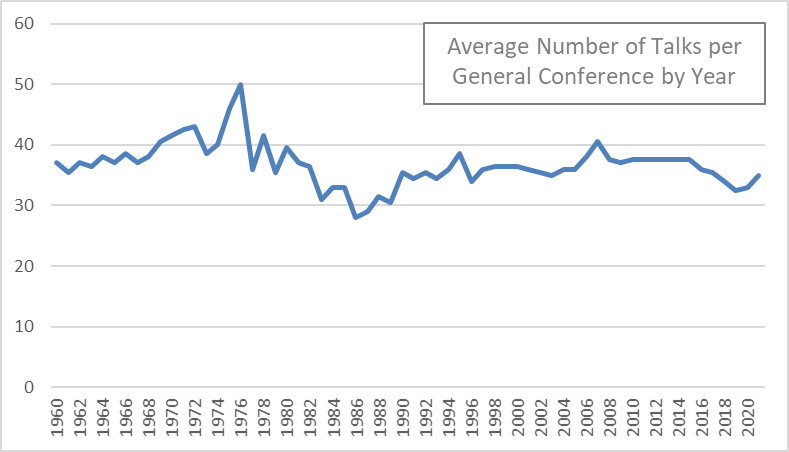
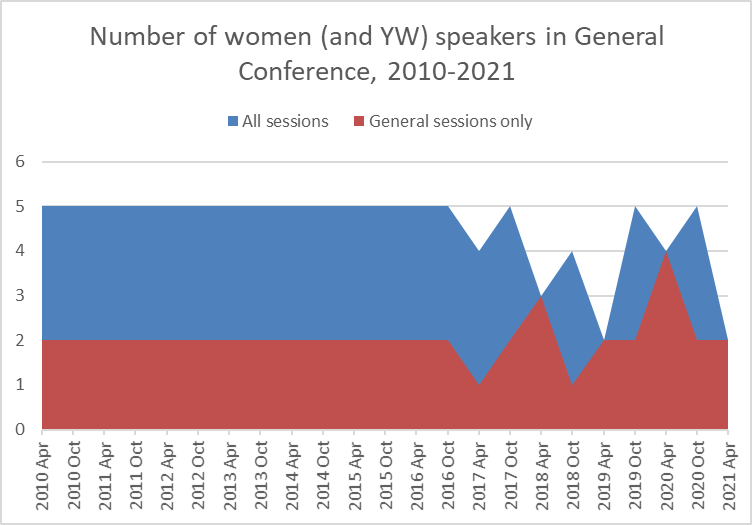 Up until the women’s session and priesthood session started alternating in April and October, there were typically two women speaking in the general sessions, plus three more in the women’s session. (The graph includes the RS and YW meetings before they were official Conference sessions.) It seems likely that two women speaking per conference is the norm we’ll go back to. This change will flow through to the rest of the curriculum too, which is so much all Conference all the time now, and we’ll hear from hardly any women at all. I’d like to hope that this was an unintended side effect of the change, but I also wouldn’t be surprised if it was a very much intended effect.




 Taylor in a meeting that Joseph Smith had always opposed the ordination of black men. Joseph F. Smith disagreed with them in 1879, but by 1908, he had come around to their point of view and reported that Joseph Smith had later declared Abel’s ordination “null and void.” Brooks hypothesizes that Joseph F. Smith’s change of heart might have been related to the recent death of Jane Manning James. She suggests that the presence of prominent black Mormons like James might have actually served as a brake for a while on such editing of recollections. In any case, I was fascinated to read this bit of connecting of dots as to how the Church went from ordaining black men at the beginning to deciding that no, in fact, black people were to be barred from both priesthood and the temple.