Before my sisters and friends started ZD, I hadn’t even heard of Exponent II. But once I got into participating in the bloggernacle, I got to know and enjoy their blog. Even more fun, through commenting there and having their bloggers comment here, I got to know some of the bloggers, and have even been lucky enough to meet some of them over the years at social gatherings and Mormon meetups like Sunstone.
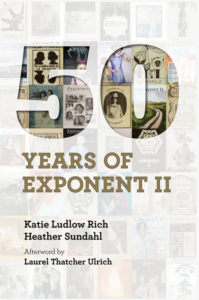
So of course I was very happy to learn that Katie Ludlow Rich and Heather Sundahl have marked the fiftieth anniversary of the organization with a book! It’s been out for almost two years now, so you’ve likely already heard about it if you’re connected to the Mormon feminist world. I’m sorry I’m so slow to getting to reading and saying anything about it, but then just last week, I wrote a post partly about a book that was first published in English in 1930, so maybe this is fast for me!
Roughly the first third of the book is a history of the organization Exponent II, from its founding in 1974 by a group of feminist-minded Mormon women in Boston, right up to 2024. I found this section fascinating, especially as someone whose knowledge of the organization has almost entirely been just in reading the blog, which in the grand scheme of things, is a janey-come-lately in comparison with the original paper. Rich and Sundahl had access to minutes of meetings of the organization, and even better, in many cases were able to interview women who had served in key roles over the years. They got into all kinds of nitty-gritty details about how the physical production of the paper was managed, in addition to the bigger picture issues like editorial decisions about topics to focus on.
I was especially interested to read about how the organization was led by a board from the beginning. I wonder if this allowed them to avoid founder’s syndrome problems, where there’s one central, often charismatic, leader who might have a hard time ceding power to others as time passes and the organization grows and has changing needs. It was fascinating too, to read about how the board often had to steer among the same kinds of competing priorities that I’ve seen come up in my own little experience in the fringe Mormon world. For example, sometimes readers new to feminism and to the magazine wanted to rehash issues that old-timers had already reached a settled view of. Or some readers wanted the magazine to be more activist or radical, but it seems like board and staff members consistently did a good job of centering the mission of sharing women’s stories and experiences without forcing them to fit in a particular framework. I liked this line from the book:
[I]n the 1970s, Exponent II emerged after a correlated, streamlined church had stripped the Relief Society of much of its institutional power and decision-making. Exponent II was interested in this history, but even as it reprinted articles from the pioneer-era paper, it did not set out to reconstruct the past or get at the truth of the past. Primarily, it offered experiential stories that added to the body of evidence of what it was like to be a Mormon woman in the last quarter of the twentieth century.
The last two-thirds of the book is a selection of articles, poems, and even occasional fiction first published in the magazine. These are arranged in five chronological sections, and then a sixth with selections from the blog. A brief introduction to each section overviews the time period and the primary issues that came up in submissions to the magazine during it. I found this to be a very helpful arrangement, and it was interesting to see the topics that came up, like the ERA, abortion, LGBTQ rights, and of course just the common, constant pressure on women trying to build their lives in such a thoroughly patriarchal church. I found this setup very helpful, a great mix of the primary documents in the original articles, where I could hear in the women’s own words what they were thinking and feeling at the time, along with the retrospective overviews to orient me to the larger world surrounding the selected pieces.
And an added fun bonus for me was that, both in the history section and in the selected pieces section, as time progressed closer to the present, I recognized more names, and even knew some of the authors. Of course this was especially true for the blog section, which includes such classics as April Carlson’s pointed and hilarious Neckties: Priesthood Attire or Lucifer’s Lust Pointer?, Amelia Parkin’s excellent The Modesty Myth: Why Covering Up Just Won’t Do, and Caroline Salisbury’s brilliantly explained The Harms of Projecting the Mormon Male Gaze Onto Young Women.
But of course the blog selections were familiar. For me, the real added value was in giving me a taste of what was written in the magazine over the years. Here are just four snippets that struck me in particular. First, Kathleen Flake in 1976 explained how sister missionaries are treated as outsiders in their own missions:
And then it is time for the [missionary] conference to close with a rousing chorus of “Ye Elders of Israel.”
Although there are countless other, more subtle way of communicating it, the message is essentially the same: “You are guests; you are different, not one of us.” Similarly, you may occasionally receive an acknowledgement not unlike an apology: “We know you’re here, but we don’t exactly know what to do with you.” There is kindness; there is courtesy; there is even chivalry. But there is rarely comradery, and almost never the respect accorded true equals.
. . . . I am convinced that much of the depression and physical illness experienced by women during their missions is a consequence of these dynamics.
Parenthetically, I wonder if these dynamics have improved at all since some of the barriers to women serving missions have been removed and far more of them are serving.
Second, here’s Shari Siebers Crall in a moving 1995 essay titled “Women’s War,” contrasting the honor given (overwhelmingly male) war veterans with the disappearance of women who suffer violence at the hands of men:
We all know the battle stories. Our neighbor down the street, our sister, ourselves. That is the point. I know a few veterans. I can think of two who saw combat; yet, in the same circle of my acquaintance, I know scores of women who have suffered violence at the hands of men, regular men who hold jobs and don’t serve time unless they finally kill one of us.
Third, Pandora Brewer, in a beautiful 1999 essay “Known to Your Bones: Living in the Company of Women,” recounts some of her experiences making friends with women in different places she’s moved to. I particularly loved this line:
The more my friend knew me and the more I knew her, the less I had to live in my own head, and the more connected I began to feel with people in general.
As a person who also lives sometimes too much in my own head, I found this really resonated. And I love her conclusion:
I have come to believe that however fulfilling my married or mothering relationships, there is no substitute for being know down to your bones, of standing by yourself, circled by women, visible, palpable, blessed.
Even as a man and so an outsider to such things, I can appreciate how powerful and supportive these connections can be.
Finally, I loved this line from Maxine Hanks in her 2015 piece “Remembering Exponent II: A Beacon in the East,” as she’s recounting how far apart Mormon feminists felt from each other:
We swam in a sea of malespeak, our voices like buoys, too far apart.
I just thought this was perfect imagery for a difficult situation!
I’m not much of a book reviewer; as you can see, I’ve fallen back on my usual approach of just quoting bits I liked. But if you like these too, and would enjoy reading a whole bunch more that will also delight and move you, you should read this book. I’m so glad that Rich and Sundahl did all the work to write the history and read through everything that’s been published to assemble such a great collection of writing pieces! It was truly a pleasure to read.