Possibilities for a Surveillance Church

You’re familiar with surveillance states. We all live in one, to one degree or another. COVID and mass working from home also brought attention to surveillance corporations, which sometimes track their employees’ every keystroke to be sure they aren’t having unauthorized fun when they should be appropriately suffering for their paychecks. (Speaking of which, I probably shouldn’t be writing this post at work.) But what about a surveillance church?

I feel like the LDS Church is ideally positioned to become a surveillance church for several reasons. First, it’s exclusive. Unlike so many American Protestants, who believe members of many churches can be okay with God, we believe we alone have essential ordinances that members of any other church are missing out on. This is important because if, say, the ELCA decided to try intrusively surveilling its members, they’d all just go down the street and become Episcopalians or something. Second, it has a top-down hierarchical structure. By contrast, if say the Southern Baptist Convention said its member churches should intrusively surveil their members, they could just ignore it or leave the organization. Third, it isn’t too large. The Catholic Church is also exclusive and top-down, but it’s so gigantic that I think it would be harder to implement a surveillance program across the whole church than it would be for Mormons. Fourth, it isn’t too small. I imagine there are a lot of much smaller churches that would love to be super controlling and surveil their members constantly, but they just don’t have the resources. The LDS Church is, of course, ridiculously wealthy. Fifth, it has multiple tiers of membership (baptism level, temple recommend level), which provides more opportunities to prod members into compliance to maintain (or improve) their position.

Okay, let’s get to my suggestions. Only they aren’t suggestions so much as just thoughts or ideas of possibilities that could happen. You can probably guess that they’re at least partly tongue in cheek. But I’m a little bit serious too. I’m thinking along the lines of the quote attributed alternatively to Ray Bradbury or Frank Herbert that science fiction writers don’t write to predict a future, but to prevent it. I hope none of these ideas come to pass, but if a true zealot became Church president, or even a more garden-variety fundamentalist leaner, I could see some of them happening.

Read More

Connection or Control?

Photo by Vonecia Carswell on Unsplash

In her book, You’re Wearing That?: Understanding Mothers and Daughters in Conversation, the linguist Deborah Tannen points out a common issue in mother/daughter dialogue that becomes more prominent as the daughters age to adulthood: Mothers raise topics of conversation in order to maintain connection with their daughters, but daughters interpret them as trying to maintain control over them. The possible topics are many: who are you dating, where are you living, what are you driving, where are you going to school, where are you working, and on and on. Either party could be right. Mothers might in fact be trying to maintain some control in their daughters’ lives when daughters are perfectly capable of making their own decisions. Or daughters may be defensively pushing back when all mothers are hoping to accomplish is to know how their daughters’ lives are going. Or, most likely, something in between is true, with mothers being a little more controlling than they need to be (even unconsciously) and daughters being a little more defensive than they need to be. It makes sense that this connection or control question could be a fraught one especially for mothers and daughters (or any parents and offspring), given that parents are necessarily completely controlling of their kids’ entire lives when they’re younger, and in most cases, the kids’ entire lives are taking steps away from the parents.

Read More

Naming the BYU Medical School

Photo by Olga Guryanova on Unsplash

The Church announced yesterday that BYU will be adding a medical school. I have some suggestions for what it could be named and different medical areas it could emphasize. Please feel free to add yours in the comments.

  • The Neil L. Andersen OB/GYN Training and Fertility Research Institute (and Medical School)
  • The John Taylor Center for Research on Preventing Injury Using Ordinary Household Objects
  • The Ronald A. Rasband Center for Discovering Doctrinal Drugs of Divine Design
  • The Dallin H. Oaks Medical School and Conversion Therapy Research Center
  • The Brigham Young School of Digestive Health
  • The David A. Bednar School for Hospice Care of People Having Faith Not to Be Healed
  • The Joseph Fielding Smith Clearinghouse of Answers to Medical Questions
  • The Dieter F. Uchdorf Healthy Sleep Research Center
  • The Jeffrey R. Holland Musket Wound Treatment (and Infliction) Center
  • The Gary E. Stevenson Medical School (brought to you by ICON Health & Fitness)
  • The Joseph F. Smith Believing Blood Research Center (and Blood Bank)
  • The Neal A. Maxwell School of Supernal Surgery

Ben Park’s American Zion and different trajectories the Church could have taken

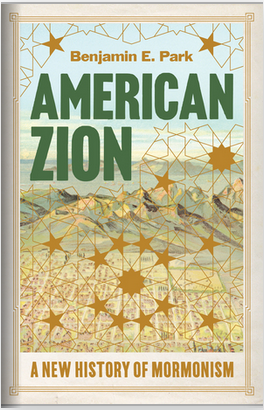
I recently read Benjamin E. Park’s new history of the Church (in the US mostly), American Zion. It was such a great read! Of course as a Mormon who’s attended church for decades and has even read a little academic Mormon history, I was familiar with a lot of the events in broad strokes, but Ben (I’m acquainted with him, so I’m going to call him that) brought in all kinds of interesting context and information about periods of time especially where my knowledge was really thin. And I was also especially interested to read how he thought about events in the last couple of decades, when I’ve been blogging about Mormon stuff and at least generally following the trends of what’s going on in and around the Church.

Here’s an example of broader context Ben brought in that I found interesting. When the Church went to the state of Ohio in 1836 to ask for a banking charter, it was a time of a lot of pressure on banks in general because Andrew Jackson had successfully defunded the national bank. People everywhere were scrambling to work out how to handle financing issues. The state granted zero banking charters during that legislative session. So it wasn’t just that they were out to get the Mormons. It was that it was a difficult time and they were caught up in a difficult situation that made hard times for a lot of people. I love reading this kind of context because I feel like so much of my knowledge of Church history and secular history more broadly (both of which are admittedly pretty thin) are in silos in my head, and it really opens up my understanding when a historian like Ben connects the appropriate dots to make the Mormon experience make more sense in the context of the US (or the world).

Read More

Ten things I loved about Steve Taysom’s biography of Joseph F. Smith, Like a Fiery Meteor

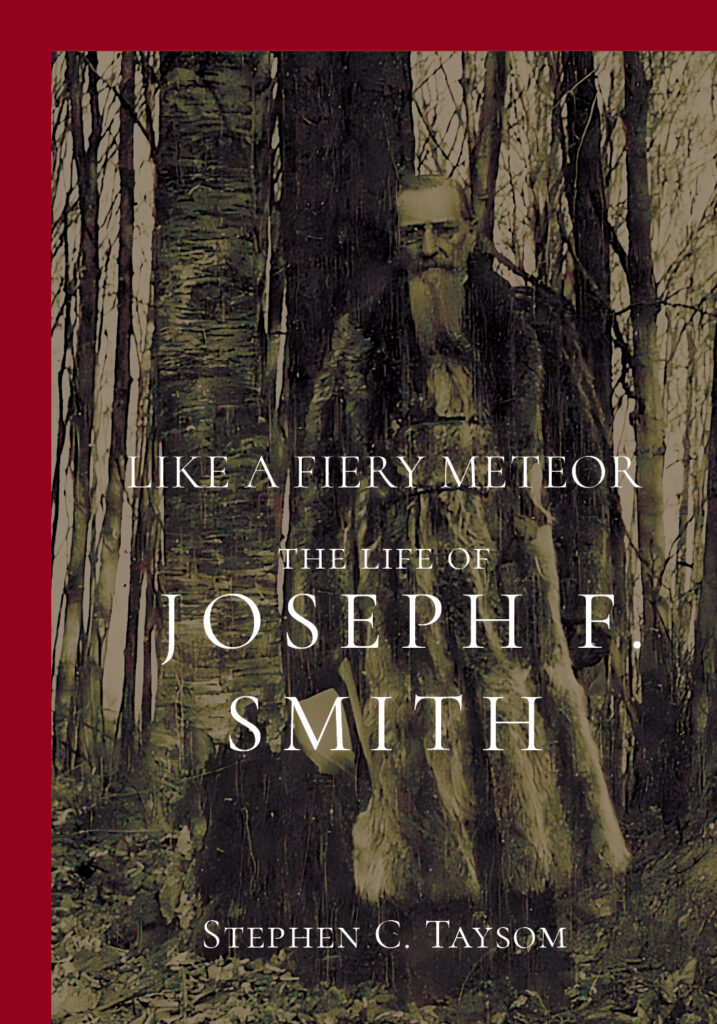
I recently read Stephen C. Taysom’s biography of Joseph F. Smith, Like a Fiery Meteor. I’m acquainted with the author, so I’m going to refer to him as Steve, because it would sound strange to my ear to call him Taysom. Also, I’m going to follow his convention of referring to Joseph F. Smith as JFS.

  • I appreciate that Steve takes his readers seriously enough to occasionally introduce a theoretical framework for understanding an event in JFS’s life. For example, when talking about the Mormon diaspora that followed the deaths of Joseph and Hyrum, he first briefly discusses diasporas in general and the idea of returning to a homeland, and then shows how Mormons were both thinking of returning to a particular place, and also to an imagined one, an idealized version of the United States. Or again, when talking about how JFS made sense of the Manifesto, both for himself and for Mormons in general, Steve first refers to a historian who’s thought about meaning-making in Judeo-Christian religions more generally, before getting into applying the historian’s ideas to the particular situation JFS was in.

Read More

Who is the gleeful gatekeeping policeman?

I really enjoyed Patrick Kearon’s talk this last General Conference. His message was well summarized by his title: “God’s Intent Is to Bring You Home.” He told the story of a policeman he once watched from a hotel window whose job for the day was to turn people away from a closed street. Elder Kearon said that the policeman looked like he was very much enjoying turning people away: “he seemed to develop a spring in his step, as if he might start doing a little jig, as each car approached the barrier.” He contrasted this policeman with God, who he said is eager to bring us home.

I thought this was a lovely message. But it seems obvious. Why would he feel the need to say it? The linguist Paul Grice came up with four maxims that appear to govern our conversational interactions. The first of these, which I think is relevant for this talk, is to be informative. We generally say things that we expect the other person doesn’t know. We want to communicate something. A Monty Python sketch provides a handy illustration of how this maxim can be violated for comic effect. When the pilot tells the passengers “There is absolutely no cause for alarm,” he of course brings up the possibility that there is cause for alarm, because why would he be telling them that if he didn’t think they might be alarmed? That is, the passengers are expecting the pilot to follow the norm of being informative. All the same goes for assuring them that “the wings are not on fire.”

Read More

Temples Announced and Temples Completed

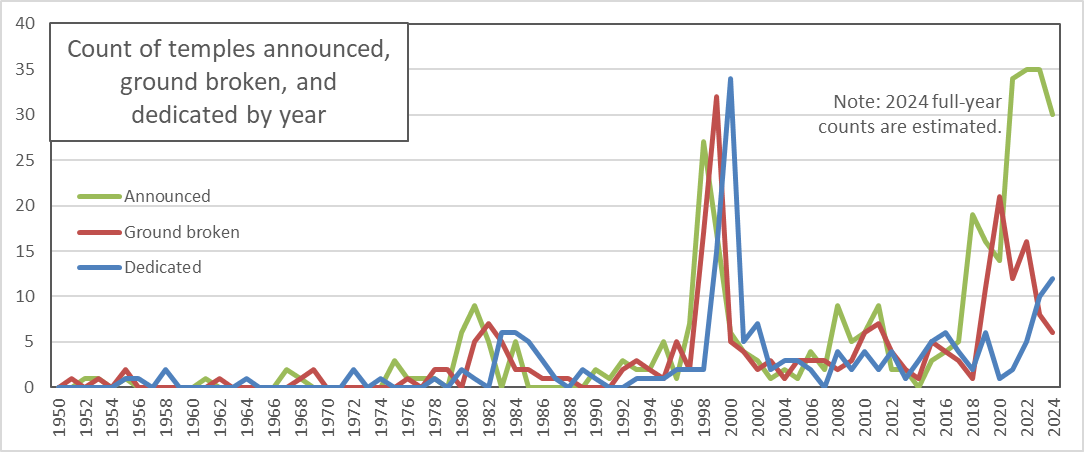
Back in 2020, I wrote a post where I looked at the large number of temples President Nelson was announcing, in contrast with the slow pace at which their construction was taking place. Of course since then, the pace of announcements has only increased. In that post, I mentioned that he had announced 24 across the previous year and a half. Now, he announced 35 new temples in each of the past two years, and slowed only a bit to 15 in Conference a few weeks ago. In this post, I’m going to update the analyses I did for the 2020 post, as well as adding a couple of new ones. Nearly all my data is just taken from the Church’s list of temples, which lists announcement, groundbreaking, and dedication dates.

This first graph shows counts of temples announced, temples having ground broken, and temples dedicated each year since 1950. Note that for 2024, I estimated announcements as two times the number we’ve already had (as we’ve had one of two Conferences), and ground breakings and dedications as three times the number we’ve already had (as we’re about a third of the way through the year).

The biggest feature is of course the turn-of-the-millennium rush to get to 100 temples, where a bunch were announced, had ground broken, and were dedicated in pretty short order. The recent increase in announcements hasn’t been followed as reliably by groundbreakings and dedications, although dedications are clearly up since the pandemic. But they aren’t nearly up to the level of announcements.

Read More

A Heretic Reviews General Conference, April 2024

Best hymn: “Oh, What Songs of the Heart,” Saturday evening. It gets bonus points for mention of Heavenly Parents, but I really liked it musically too.
Worst hymn:  “Lord, I Would Follow Thee,” Sunday morning. This was just very bland.
Fastest hymn: “The Lord Is My Light,” Saturday evening.
Slowest hymn: “Did You Think to Pray?” Saturday morning.
Best and worst choir: I really liked the Utah Valley Institute choir that sang Saturday evening. I was much less a fan of the BYU-I choir that sang Saturday afternoon. It wasn’t a knock on their singing; I just felt like the arrangements they sang had weird pacing changes. (Sorry, as a music noob, I can’t explain it any better.)

Longest prayer: 167 seconds, S. Gifford Nielsen, Saturday morning invocation.
Shortest prayer: 51 seconds, Emily Belle Freeman, Saturday afternoon benediction. I appreciated that she didn’t force herself to use proper prayer pronouns.
Unsurprising prayer difference: Men gave eight prayers, with the shortest being 93 seconds (average of 114 seconds). Women gave two prayers, with the longer being 68 seconds.

Best slip of the tongue: While conducting the Sunday afternoon session, Quentin L. Cook welcomed us to the 109th annual General Conference. (It was actually the 194th.)

Best title: Patrick Kearon, “God’s Intent Is to Bring You Home”
Overdone title: Dale G. Renlund, “The Powerful, Virtuous Cycle of the Doctrine of Christ” I didn’t realize until I read the talk that he was quoting Russell M. Nelson, who has a love of hyperbole.

Longest talk: D. Todd Christofferson, 1961 words. (He also gave the longest talk among Q15 members last conference.)
Shortest talk: Susan H. Porter, 1252 words.

Best laugh:

  • Dale G. Renlund showed with his hands the sizes of the tiny waves that knocked him off his kayak.
  • Massimo De Feo told how his wife told him the reason he didn’t remember them having any major problems was that he had a short memory.

Strangest joke: Jeffrey R. Holland, who hadn’t given a talk in a couple of conferences because of health issues, joked that it was because he gave a bad talk last time. He said that he was at risk of being banned again, “positioned on a trapdoor with a very delicate latch.” While I appreciate his willingness to laugh at himself, I found this an odd choice of jokes precisely because we have seen that speakers don’t get removed from the rotation if they do bad things. You can try to stealth canonize your favorite proclamation and still come back. You can openly set up a money-making scheme and still come back. It seems like a weird thing to call attention to.

Bad pattern: There was wall-to-wall discussion of temples and covenants. Two speakers—J. Anette Dennis and Dallin H. Oaks—brought up temple garments, which I feel like are mentioned in conference rarely if ever. (Gerrit W. Gong even exhorted members to buy our own temple clothes.) I have to wonder if President Nelson has noticed that maybe all the new temples he’s announcing aren’t drawing as much new patronage as he had hoped, so now he’s trying to drum up some more traffic to make them look more successful. This discussion showed up in some strange lines:

  • Jack N. Gerard said that in performing the atonement, Jesus “fulfilled the covenant He had made with His Father.” I feel like I’ve never heard this called a covenant before. Is this new doctrine?
  • Andrea Muñoz Spannaus said that “obeying our covenants” is one key to drawing on the power of Christ. Obeying? I’ve heard keeping, but a covenant isn’t a commandment or a rule.
  • Ulisses Soares assured us that “having the spirit of the Lord’s house in us changes us, completely.” Wait, so the temple has its own spirit now? Is the Holy Ghost at risk of being displaced?

Beloved buzzwords:

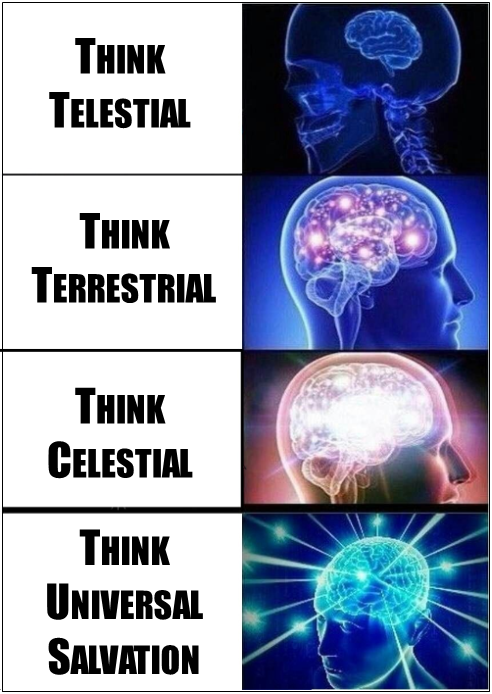
  • Russell M. Nelson’s “think celestial” line from last conference was picked up and repeated by a number of speakers, sometimes in strange ways. For example, Neil L. Andersen, with a reference to D&C 87, said that “[The Lord] spoke of a righteous people resisting the deceptions of the adversary, disciplining their faith, thinking celestial, . . .” Really? He spoke of that?
  • There’s clearly been a push to call temples “houses of the Lord.” This often sounds clumsy. For example, here’s the opening to David A. Bednar’s talk: “During a recent open house and media day for a new house of the Lord, . . .” Of course, President Nelson has also pushed to use the full name of the Church, regardless of how or where it doesn’t fit, so he’s clearly not one to be deterred by verbal clumsiness.
  • Ronald A. Rasband appears to not be able to give a talk without saying “by divine design.”

Read More

Reading Comments on the Church’s Instagram Post

A couple of weeks ago, the Church put up an Instagram post with a quote from J. Anette Dennis of the Relief Society General Presidency from her talk in the Relief Society broadcast. The quote begins, speaking of the Church:

There is no other religious organization in the world, that I know of, that has so broadly given power and authority to women.

The quote continues for a couple of paragraphs that add some context, but it has been edited since it was first put up, and I believe it was originally just this quote. In any case, it drew thousands of comments on Instagram, many from commenters saying this is obviously false. Comments were deleted a couple of days into the discussion, which provoked further outrage and sadness from commenters, but fortunately they were eventually restored and the discussion continued. The Church social media team (and many commenters) said this was a broader platform issue, although a Meta spokesperson quoted in a New York Times story (gift article—no subscription required) denied this.

The blowup was also covered in the Salt Lake Tribune. From the more apologetic side, the Deseret News published a couple of opinion pieces from women who don’t feel unequal in the Church, and Public Square Magazine put up a response to the New York Times article. From the more critical side, the Salt Lake Tribune published an opinion piece from Rosemary Card, April Young Bennett at the Exponent traced the line of thinking to then-Elder Oaks trying to placate Ordain Women a decade ago, and Lisa Torcasso Downing at Outside the Book of Mormon Belt wrote an extensive response to an apologetic post on Facebook. Molly at Roots and Reckoning also curated and categorized a few hundred of the best quotes from the Instagram discussion at her blog.

I thought it would be interesting to read all the Instagram comments. I found a handy tool called IGCommentExporter, and it pulled 12,578 comments into a csv file for me. I read through them and tagged them with themes they brought up and noted some of my favorites, and that’s what I’ll tell you about in this post.

Before I get to that, though, let me tell you about some limitations in the data and my work:

  • Instagram currently says there are over 17,000 comments on the post, so when I scraped them on March 21st to start this project, I only got about 70% of them. This means that I didn’t include Sister Dennis’s follow-up comment, or any responses to it.
  • At least a few people appear to have deleted their comments. I say this because in what I read, there were a lot of responses tagging commenters who appeared to have few to no comments themselves.
  • The comment scraper couldn’t give me the structure of the comments, by which I mean which were replies to another commenter and which were top level. I was able to reconstruct this for about 6,000 comments by just manually loading them in my browser and using a link scraper, but for the rest, I just had to infer based on timing and who, if anyone commenters tagged.
  • You can probably guess my bias, but just to be clear, I agree with April Young Bennett. I think the whole idea of women having the priesthood in some way is clearly just a hand-wavy explanation that Dallin H. Oaks came up with in an attempt to shut Ordain Women up without actually making any changes in the Church. The only way Sister Dennis’s quote can be made sense of is to start with the idea that LDS priesthood is real and all others are fake, so of course any access to it at all—even mediated through men—is better than even the best access to the fake priesthoods of other churches. (By the same logic, you could make all kinds of other absurd arguments, like that LDS churches are the most beautiful churches in the world because they’re the only real churches, and everyone else is just “playing church” [thanks, Brad Wilcox].)
  • I’m sure my bias played into how I tagged themes in comments. As you’ll see, I used more granular theme tags for critical comments than apologetic ones.
  • I probably should have made the theme tagging more granular in general, but at some point, reading through all the comments was a long process, and I had to stop tinkering with it and go with what I had.
  • Even setting aside my biases, I probably wasn’t the most reliable tagger, meaning that if I had read through the comments more than once, I likely wouldn’t have assigned exactly the same set of tags both times. (Serious researchers do things like estimate reliability of people doing ratings by having multiple raters, but it would seem unfair to rope anyone else into reading all the comments with me.)
  • I couldn’t always figure out commenters’ meaning, especially when they commented with only an emoji. For example, it was hard to distinguish laughing at from laughing with. I was fortunate that I could ask my teenage daughter the meaning of a few slang terms.
  • I had hoped to do some analysis of likes of comments, but unfortunately my comment scraper didn’t gather them. I tried to sample some manually, but it was clear that Instagram was showing me commenters it thought I would like first, so my sample was inevitably going to be biased, so I had to give this up.

Is that enough caveats? Okay, here’s what I found. I read 12,578 comments. I assigned each comment at least one tag, a total of 16,921 tags, or about 1.3 per comment. This graph shows how often the tags were used.

Read More

New Direction in Latter-day Saint Temple Plan

Flush with success after its recent purchase of the Kirtland Temple from its sibling church, Community of Christ, the Church of Jesus Christ of Latter-day Saints announced today that it will be attempting to purchase other historic religious sites. Spokesman Orson Pratt-Whitney-Young explained that although the Church has expanded its temple-building program under the leadership of President Russell M. Nelson, that the acquisition of the Kirtland Temple “opened his mind to a vision of expanding our temple program in another direction.” Specifically, Pratt-Whitney-Young explained that the Church will be making offers of purchase on historic religious sites all over the world that are not related to the Latter-day Saint tradition.

For example, the Church has communicated to the government of England an interest in purchasing Stonehenge, the famed prehistoric megalithic structure. Although the site dates back to around 3100 BC and the Latter-day Saint Church only to 1830 AD, Pratt-Whitney-Young explained that some members of the Church believe there is a connection through the Jaredites, a group of people who fled the Tower of Babel in one of the faith’s books of scripture, the Book of Mormon. (In a later question-and-answer session, Young added that a former Church member is planning to publish a book outlining the connection, to be titled The Stonehenge Hypothesis.) Although the Crown has shown no interest in selling, Pratt-Whitney-Young maintained that the Church remains hopeful. He supplied an artist’s rendition of what the site would look like after the Church had made some “minor modifications” to “ensure the security of the site.” All would be welcome to visit the site once the Church owned it, he explained, although only qualified members of the faith would be permitted in the “tastefully small” Latter-day Saint temple to be built inside the iconic ring of massive stones.

In addition to Stonehenge, Pratt-Whitney-Young listed the following sites that the Church will be attempting to purchase from their current owners:

  • Notre-Dame de Paris in Paris, France
  • Hagia Sofia Grand Mosque in Istanbul, Turkey
  • The statue Christ the Redeemer in Rio de Janeiro, Brazil
  • Saint Basil’s Cathedral in Moscow, Russia

Pratt-Whitney-Young conceded on questioning that none of the other governments or religious organizations who currently own these sites has shown interest in selling. He pointed out, though, that the Latter-day Saint Church has “been led to amass great wealth by the hand of the Lord” (the Church has large real estate holdings, as well as a stock portfolio valued in the hundreds of billions of dollars) and that this wealth might be used to change the minds of reluctant government and religious officials. “Governments trust in the arm of flesh, and this leads them to the iniquity of endless borrowing,” he explained. “Perhaps one day when their debt grows too great, they will see the wisdom in accepting our offers.”

Conference Predictions

Image credit: Openclipart

If we’re between Palm Sunday and Easter, that must mean it’s Holy Week. But more importantly for members of the Church of Jesus Christ of Latter-day Saints, after Easter comes General Conference! I have some guesses about things we will and won’t hear about.

  • Church purchase of Kirtland Temple: 70%
  • Church top purchaser of land in Nebraska: << 1%
  • Church purchase of Pacific Gateway Industrial development in 2022: << 1%
  • Kirtland Temple, the first temple of the Restoration: 90%
  • Kirtland Safety Society, the first financial institution of the Restoration: < 1%

Read More

Utah Temple Utilization in 2023

When I blogged last month looking at temple activity in Utah, and how patrons move between temples when their first choice is closed, several commenters asked about utilization: What fraction of endowment session seats are being filled? In this post, I’ll show some summaries from the same endowment session data I used in the last post.

But first, commenters also pointed out that I left out a huge disclaimer in that post: The data I have is only for people who schedule online. Online scheduling is still relatively new (maybe even only becoming available during Russell M. Nelson’s presidency if I remember right), and many members therefore have decades of experience just going to the temple for endowment sessions and counting on open space being available. So it wouldn’t be surprising if a substantial fraction of temple patrons don’t show up in my analysis because they didn’t schedule online. Also, to be complete, it’s also possible that people could schedule a place but then not show up for their appointment, although I’d guess that’s probably less common. In sum, the true attendance numbers are very likely higher, perhaps much higher, than what I’m showing. I’d love to hear from anyone who’s a temple worker or attender what their impression is of how many people attend without scheduling online or how many schedule online and then don’t attend. And thanks again to commenters on my last post who raised this issue and shared their experience with this.

While I’m offering that big caveat, let me tell you about two other smaller one related to data exclusion. First, in looking at utilization, I’m using only English language sessions. Utilization rates for sessions in other languages are affected by a second effect in addition to members’ general interest in attending the temple: the number of members nearby who speak the language the session is presented in. For English, there are presumably always plenty of members nearby who speak the language, so differences in utilization can be attributed more straightforwardly to differences in willingness to attend. The second exclusion of data is that I dropped all Monday sessions. Provo consistently had a few sessions on Mondays, but because it was the only temple open for endowments that day, I didn’t consistently gather the data. It’s only a small number of sessions anyway, so I just excluded all Mondays.

This first graph shows counts of total endowment session seats and seats used, aggregated across all Utah temples.

Read More

Sunstone Kirtland Memories

The LDS Church purchased some historic sites, documents, and artifacts from Community of Christ last week. If you read Mormon stuff on the internet, you’ve probably already heard plenty of commentary on the exchange. I have little to add to the commentary I’ve read. I feel especially bad for people I know in Community of Christ for whom this blow came out of left field.

Of the historic sites sold, the Kirtland Temple is probably the most recognizable. It’s also the most important to me personally. My family moved to the Midwest about a decade ago, and since then I’ve gotten to visit Kirtland a number of times. I’ve always been more impressed with Community of Christ’s presentations and tours at the temple than the LDS Church’s presentations and tours up the road at and around the Newel K. Whitney store. This is a common complaint, but it’s true: LDS tours are typically designed to use history as a prop to wring correlated spiritual experiences and missionary referrals out of visitors. Community of Christ tours, on the other hand, are more like actual historical tours where the guides try to give an overview of important events that happened at the sites, leaving the interpretation up to the visitors. I don’t have high hopes that the LDS Church’s tours of the Kirtland Temple will be anything other than the carefully correlated bland stuff that’s our usual.

Image credit: John Hamer on Wikimedia.

Several of my Kirtland visits have been for Sunstone Kirtland conferences. These have always been generously hosted by Community of Christ at the visitor center next to the temple. I’m guessing the LDS Church won’t want to host such heresies there, so these conferences will likely be held at another venue, if they continue at all. I thought it might be fun, then, to reflect on some of the things I’ve enjoyed most at Sunstone Kirtland.

I do want to note that I’ve been to the main Sunstone conference in Salt Lake a few times too, and I’ve also enjoyed it a lot. It’s great that there are so many interesting people and different presentations. In Kirtland, I feel like we’ve rarely even had concurrent sessions, where you get to choose which you want to go to. But the small size is also a benefit in that it’s so much easier to meet someone if I want to. If I want to ask a presenter a follow-up question, or even just meet them, after a session at Kirtland, it’s always been easy.

Another aspect that was always great is that we’d start or end with a tour of the temple. These were always done by super knowledgeable people who could tell us all kinds of interesting things. At least once, Lachlan Mackay, a historian who’s on the Community of Christ Council of Twelve, did the tour. If you’ve been to the temple, you probably remember that the doors have been painted green because historical research indicates that that was their original color. If my memory is correct, Mackay told us on a tour that the exterior walls were originally slate gray, but he hadn’t been able to persuade everyone to go back to that color like with the doors.

Here are some conference sessions I particularly enjoyed. (To protect people’s privacy, I’m giving names of presenters and people I met at the conferences only if they’re public figures to some degree.)

  • A presenter one year explained how she had purchased Bratz dolls and then re-made them to look like each of Joseph Smith’s wives. She showed the collection during her presentation. It was a great demonstration of how a number (41, or whatever it is) fails to capture just how many women he married.

Read More

Nephi’s Blunder

The Lord commanded Nephi to cut off Laban’s head.
After some reluctance, he chopped and made him dead.
Murder was good: Laban was a wicked man.
Nephi and his kin got brass plates as God planned.

Photo by Guilherme Stecanella on Unsplash

Chorus:
“I will go; I will do the thing the Lord commands.
I know the Lord provides a way; he wants me to obey.
I will go; I will do the thing the Lord commands.
I know the Lord provides a way; he wants me to obey.”

The Lord told Abraham he must kill his only son.
He took Isaac with him to get the Lord’s will done.
When ready to kill, at last his knife he drew,
Broke in then an angel: “God was testing you.”

Chorus

The Lord commanded Thomas to exclude kids of gays.
Never to baptize them in all their youthful days.
Thomas and Russell knew they were in a bind.
Finally years later, Russell changed God’s mind.

Chorus

Read More

Do new temples bring new patrons?

As the Church rushes to build ever more temples for a membership that’s now growing only slowly, the GAs must face the question of whether new temples are actually bringing in new patrons. Because that’s the goal, I would think: to make the temple accessible to members who couldn’t get to it before.

When a temple is first built in a place, a country or a region of a large country, it should draw in many new patrons who couldn’t attend (or at least couldn’t attend regularly) before. In large countries like Brazil or countries where travel may be difficult like The Philippines (I’m just guessing, with all the islands), it makes sense that building temples in different regions would make temple attendance accessible to more members. But at some point, when most members who want to go can go, a new temple is likely to just redirect temple patrons from one to another rather than actually bringing in anyone new.

Utah is the obvious place where this point of diminishing returns for new temples is coming, if in fact it hasn’t already arrived. I thought it would be interesting to take a look at attendance there as a preview for what might happen as more and more parts of the world approach a point of temple saturation.

Between April and December of last year, on a nearly daily basis, I checked the number of available seats for endowment sessions in each temple in Utah for the next day. I also checked the number of available seats for sessions a month or two in the future to get an idea of each session’s capacity. (And to account for the fact that a few seats are scheduled even a month or two out, I took the capacity for each session as the maximum of any capacity for a session on the same day of the week and at the same time on any day within 60 days of the day of the session.) I then took the difference between capacity and seats remaining the day before as the number of endowment session patrons.

I originally planned to show graphs of daily patron counts, but there’s so much variation within weeks that it’s hard to see trends, so I’m going to show weekly counts instead. Also, to make the data easier to look at, when a temple was closed for just one day (like July 4th) or for the few days when I missed gathering data, I filled the day in with the average for the same day of the week within 30 days in the past or future.

Because the question I’m interested in is the effect of one temple on another nearby, I’ll show a few pairs of nearby temples. Here are Jordan River and Draper.

Both temples show increased attendance when the other closed. In May, when Jordan River closed, Draper’s weekly counts went from about 2600 to about 3000. And again in October, its weekly counts went from about 1800-1900 to about 2800. On the Jordan River side, when Draper closed in July, its weekly count went from the range of 6000-7000 to nearly 8000.

Read More

Nacle Notebook 2023: Funniest Comments

This post is a list of the funniest comments (and lines in posts) that I read on the Bloggernacle last year. Even among the comments, I’ve typically excerpted just a part of a longer comment. Each person’s name is a link back to the original comment or post, so you can go and see the larger context if you’re interested.

In case you haven’t read them yet, here are links to compilations for previous years: 2022 2021 2020 2019 2018 2017 2016 2015 2014 2013 2012 2011 2010 2009 2008.

Jack Hughes, commenting on Dave B.’s post “Next Up: New Testament” at W&T:

I believe in the basic Gospel teaching principle of “line upon line”, but not “repeat the 4th grade every year for the rest of your life”. That’s not what I signed up for.

Anna, commenting on Bishop Bill’s post “Love (terms and conditions apply)” at W&T:

See, most people base their idea of God on their parents because when we are infants, our parents are very God like. And sometimes we disobey and our parents don’t notice or simply fail to punish us. And so as an adult, we disobey God and go down to the honey tonk and take someone home to copulate like rabbits, and no immediate consequences follow, and hey that was fun.

Photo by Noah Buscher on Unsplash. Orange you glad I selected it?

Old Man, commenting on Elisa’s post “Royal Defectors” at W&T:

Some time ago I sought clarification regarding an apostle’s military record from the history dept. (The local seminary teachers were spreading some faith-promoting falsehoods.) The history folks forwarded my phone call and I ended up discussing the issue with that apostle. He laughed and shouted at me while his secretary held up the phone “Don’t believe everything you hear from CES.”

Read More

I’m thrilled that Patrick Kearon has been called to the Q12!

The Church announced a few days ago that Patrick Kearon of the Seventy has been called into the Quorum of the Twelve to fill the vacancy created by M. Russell Ballard’s death. I’m very happy at President Nelson’s choice.

Image credit: churchofjesuschrist.org

First, I’m of course a complainer, so I do want to mention a few concerns I have. One is that President Nelson seems to be in a rush in not wanting to wait for Conference, and having Elder Kearon ordained already really makes clear that sustaining votes from the membership are 100% loyalty tests, and not at all what they originally were. Another is that it’s too bad the Q15 remains so white. And old. And of course you know I’d love to see women ordained and have a woman called.

But setting those issues aside as large ones that the Church is not likely to move on soon, like I say in the title, I’m thrilled with the selection of Patrick Kearon. Here are some reasons why:

  • He’s not an American. I think American GAs are more prone to thinking that American (or Mormon corridor) cultural norms are God-inspired.
  • He’s an adult convert. He was baptized in 1987 at the age of 26. I see this as a positive in the same way as I see not being an American as a positive, but I think being a convert might be even better. I feel like there are so many “unwritten order of things” ideas that float around the Church and someone who wasn’t raised in the Church would be so much less likely to taking these seriously just because he didn’t hear them or observe them off and on during his formative years. Ideas like this sometimes even make it into the Handbook, as Dallin H. Oaks recently illustrated with his right-hand-for-the-sacrament rule. I just think a convert would be more likely to see through this nonsense, and be unwilling to enshrine it in written rules.
  • He doesn’t use a middle initial. This makes two Q15 members in a row, after Ulisses Soares. I don’t know the history of the tradition of having GAs be referred to with their middle initials, other than that among Church presidents, it appears to date to Joseph F. Smith. For him, George Albert Smith, and Ezra Taft Benson, it seems like their middle initials or names had genuine value for disambiguation. But for most GAs, it just feels pretentious.
  • He gave one of the best Conference talks in recent memory in 2022, when he addressed abuse victims far more compassionately than any previous Conference speaker that I remember had.
  • In 2016, he gave another excellent Conference talk, urging compassion for refugees.
  • His kind approach is even more striking when considered against the backdrop of some other Seventies who appear to be auditioning for the Twelve by showing how harsh they can be. If one of these meaner men had been called, what kind of a signal would that have sent, versus the signal sent by calling Elder Kearon?
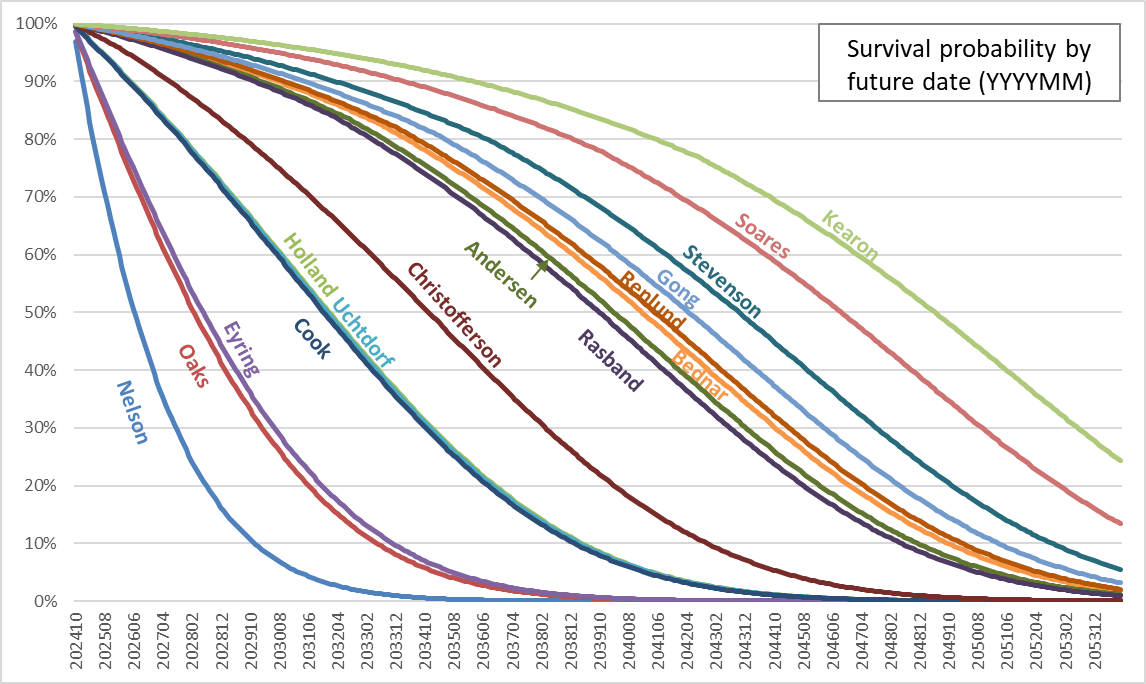
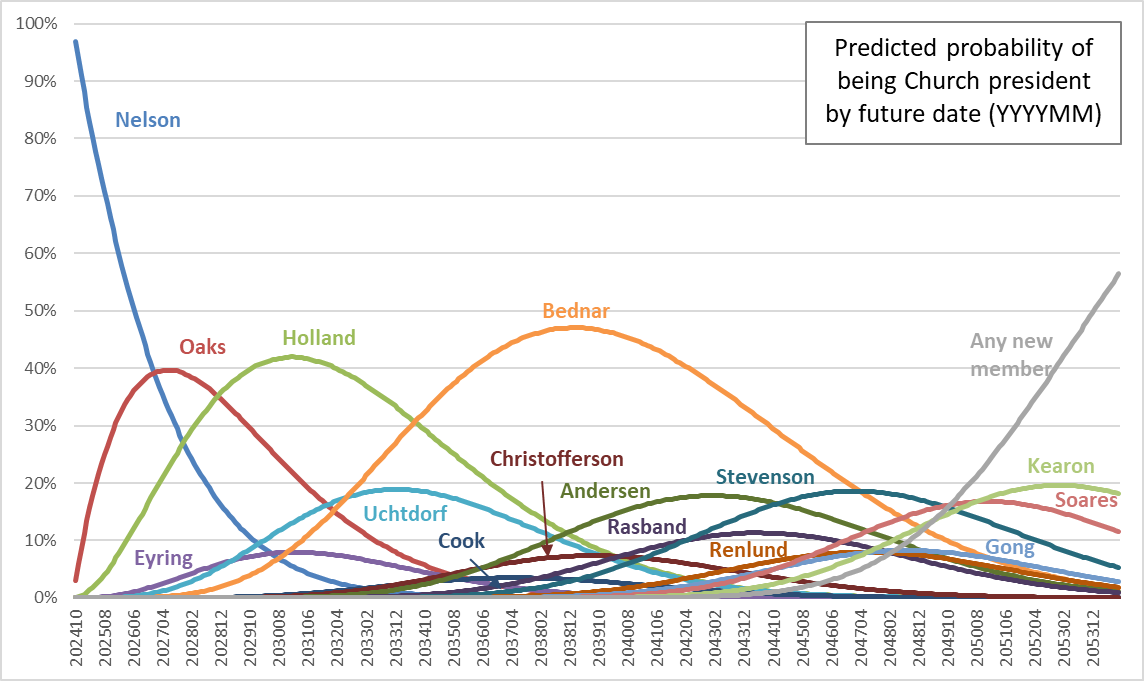
  • He’s 62, three years younger than Elder Soares, who’s the second-youngest Q15 member. This gives him a fair shot of making the top spot (eventually) and hopefully having even more of an influence for good in the Church.

What do you think of the call of Patrick Kearon to the Quorum of the Twelve?