When I wrote a review of Conference back in April, I noticed that the prayers were noticeably longer in this Conference than last October’s. It got me to thinking that although I have an intuitive sense of what feels like a short or a long prayer, I don’t know what actually counts as a short or a long prayer in comparison with other prayers in Conference. I was also interested to know whether there has been any trend over time in prayer length. Like maybe a new Church President sent a memo to all prayer-givers to tell them to hustle things along in their prayers, so they suddenly got shorter. And of course now that we’ve had women praying in general sessions for several years, an obvious question is whether their prayers are similar in length to the men’s or shorter (or longer!) My guess was that they would be shorter, given that men are encouraged to take up more space in every other area of the Church.
To answer these questions, I watched a bunch of videos of the beginnings and ends of General Conference sessions and noted who was praying and timed the prayers. The videos came from the Church’s General Conference YouTube channel and to the General Conference page on the Church website. Although there are videos of individual talks going back to 1971, there are only full session videos going back to about 2005, with occasional sessions or parts of sessions available for another decade before that.
As an aside, I’m serious about saying “parts of sessions.” The Church’s YouTube channel videos of full sessions are good for recent Conferences, but as you go back, they have lots of errors. There are several videos that are labeled as full sessions, but they end after five or ten minutes. There are a few that are mislabeled, which I only realized when the introduction in the video itself said it was a different year than the labeling of the video did. There’s even one video that shows the same session twice, back-to-back. On the Church website itself, there are a lot of sessions that claim to have video (i.e., there is a link to watch) but then they can’t be played. And there’s also at least some mislabeling. Fortunately, in at least some cases, the audio-only recording works. I submitted feedback on the Church’s website, but I couldn’t find a way to do so on its YouTube Conference channel. I know this is an extremely long shot, but if you happen to know how I could reach whoever is running it, I would be happy to supply a list of issues that need to be fixed.
Okay, on to the data! I noted lengths for 381 prayers between 1996 and 2020. (You’d think I would have had an even number since each session has two prayers, but like I was complaining about above, a few of the videos include only the opening prayer.) The average length was 93 seconds. This is within the range I expected, and it’s also consistent with my sense of what constitutes a long prayer, as while watching all these prayers, I typically started to feel like they were dragging when they went over about 100 seconds. It’s just unfortunate that older session videos aren’t available too, because I recall Conference prayers in the 1980s when I was a kid sometimes going on what felt like forever. Looking back, though, I wonder if it wasn’t just my age and shorter attention span that made them feel extra long.
This graph shows average length across time.
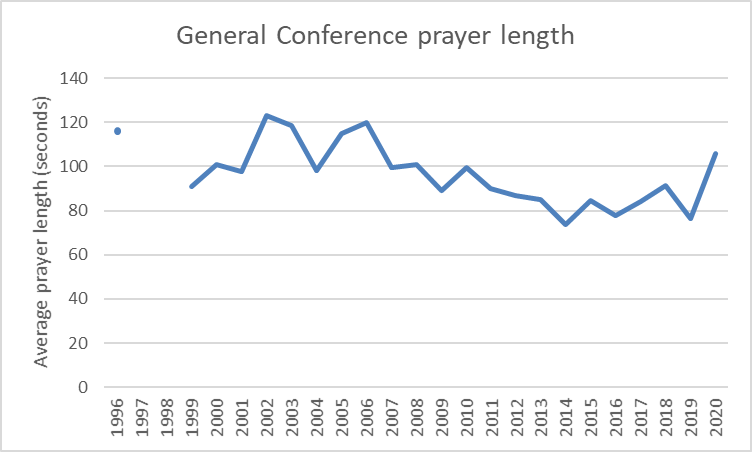
Note that the dot for 1996 is just because there were no recordings available for 1997 or 1998. It looks like maybe prayers were longer in the Hinckley years than in the Monson years. Maybe.
Read More
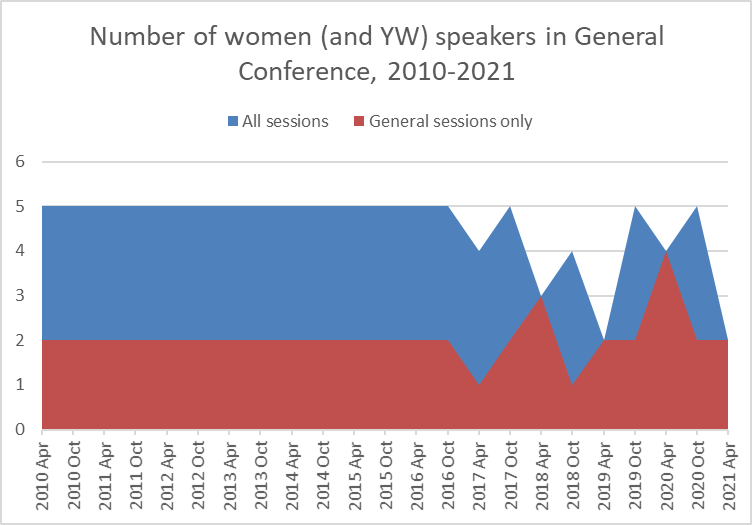 Up until the women’s session and priesthood session started alternating in April and October, there were typically two women speaking in the general sessions, plus three more in the women’s session. (The graph includes the RS and YW meetings before they were official Conference sessions.) It seems likely that two women speaking per conference is the norm we’ll go back to. This change will flow through to the rest of the curriculum too, which is so much all Conference all the time now, and we’ll hear from hardly any women at all. I’d like to hope that this was an unintended side effect of the change, but I also wouldn’t be surprised if it was a very much intended effect.

 In a stunning rebuke of the murmurnacle, President Nelson will announce that not only will the three hour block not be shortened to two hours, it will actually be lengthened to four hours. Existing meetings and classes will not be changed in length. The extra hour will be used for a mandatory meeting where all ward members (including primary and nursery-aged children) sit in council and discuss the importance of Defending the Family. Meetinghouses used by three wards will follow the 8-12/10-2/12-4 schedule. Fifth Sundays will be celebrated with a special five-hour block, with each meeting lengthened by 25%.
#/media/File:Lds_conference_center_theater_2.jpg)
