Over a decade ago (have I really been blogging that long?), I wrote a couple of posts (2011, 2014) where I counted up articles in Church magazines that talked about modesty in dress. Briefly, I found that modesty rhetoric had really ramped up since the turn of the millennium, and not surprisingly, was aimed more at women and girls than at men and boys.
In this post, I’m updating my 2014 post to include ten more years of data. I used the same scoring method that I did in 2014. (The gist is that I used Google to search for articles from magazines on the Church website that used forms of the word modest, and then scored each article for roughly what fraction was about modesty in dress, and also whether it was targeted at women/girls, men/boys, or both.) This graph shows what I found.
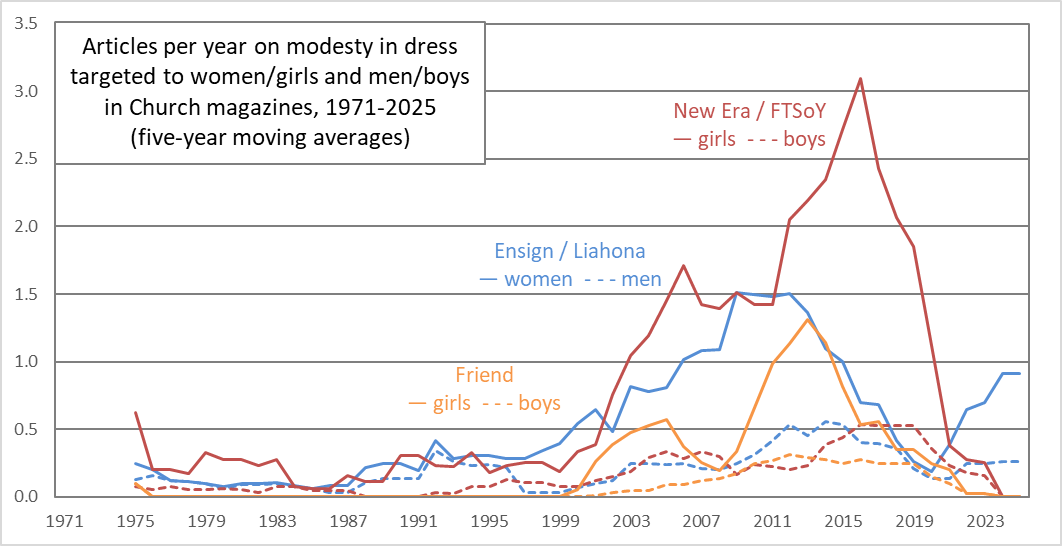
The bottom line, like I said in the title, is that there’s been a dramatic decrease since about the time I wrote my last post. This has been particularly noticeable for teen girls, who as far as I can tell haven’t been talked to about modesty since before the pandemic. This trend seems consistent with the Church’s introduction in 2022 of a new For the Strength of Youth pamphlet that is generally less prescriptive and more principles-based. And I noticed in reading the articles that do talk about modesty that they seem much more matter-of-fact and less frantic than previous ones. For example, here’s a good one from the New Era in 2019.
Adult women, on the other hand, have seen a modest 😉 increase in rhetoric aimed at them in the past few years. This also seems consistent with increased focus from the Church on the importance of wearing temple garments, with for example J. Anette Dennis and Dallin H. Oaks talking about it in Conference last year. Of course this focus is mostly on women, as women’s garments are less compatible with commonly available women’s clothes than men’s are with men’s clothes, and in a patriarchal church like ours, women’s dress will always be seen as more of an issue than men’s.
So, two cheers for the results, for teen girls and children in general anyway. It’s definitely a positive step when we can back off body shaming young people who are often the most psychologically vulnerable among us. And for the adult women, I can hope that the new sleeveless-leaning ones will maybe reduce the friction between garments and typical clothing styles a little, and perhaps encourage GAs to worry about something more substantial in their Conference talks.



 im visiting church groups in different places. I especially liked this one where he’s shaking hands with a line of people, including a young man who not only isn’t wearing a white shirt, but is wearing a black shirt and a white tie! I appreciate the young man’s subversion of Mormon norms.







 Best image: I like Robert Zund’s Road to Emmaus painting that