A Faith for This Life

My decision to convert away from the LDS church was undeniably overdetermined. So many different factors; so many different threads. Some of them, I suspect, could have sparked the decision all on their own. And like so many life narratives of momentous events, already I note that I tell different versions of it at different times. The story is never quite the same. I imagine that I will continue to make sense of it all in new ways and with other perspectives as time goes by. So I can’t really say of any particular factor, this is the one thing that led to it all. However, when I look at major issues, one that I see being very deeply rooted is that I hit a point where I desperately wanted a religious tradition that had something to offer in this life, and not just the next one. Read More

Finally Leaving

I still remember a Sunday when I was a young teenager, when the bishop felt impressed to get up at the end of sacrament meeting and share some counsel. I don’t remember any of the specifics of what he said. But I remember how he concluded his talk: in a voice of utter certainty, he said, “This is the will of the Lord for this ward.” And I loved that he said that. It made me feel so safe. God was aware of and interested in our ward, so tiny in comparison to the great vast world. God would send direction through priesthood leadership about even small decisions and issues. Weren’t we lucky to have that, while other people had to deal with uncertainty and doubt. We had a sure connection to God. Read More

Are you ready for four times as much Satan?

President Nelson said in Priesthood Session last night that Satan is quadrupling his efforts against LDS members. But what exactly does this mean? I have some theories.

Image credit: www.Vecteezy.com
  • In addition to riding on and controlling the waters, Satan now also controls three additional liquids: chocolate milk, mercury, and blood. Missionaries will be prohibited to consume, swim in, or ride in a boat on any of these.
  • Satan now leads away four thirds of the host of heaven rather than merely one. This requires him to lead some stubborn host members away more than once. (The fact that he has to do this explains why any host members remained on God’s side at all.)

Read More

Some Thoughts on the End of the Exclusion Policy

The Church announced today that the exclusion policy of November 2015, which branded people in gay marriages as apostates and denied blessing and baptism to their children, is ending. I have a bunch of thoughts on this that I’d like to share (most of which I’ve probably borrowed in one form or another from discussions with friends on Facebook).

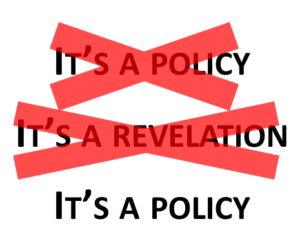
  • First, I’m thrilled! The exclusion policy was terrible from the beginning. It was bad in its direct effect of exclusion, but perhaps even worse in the signal it sent to LGBT people that they are seen as uniquely wicked by the Church, requiring a special bit in the Handbook to outline just how awful they are. I am therefore very happy to see the Q15 decide to drop it.
  • I am honestly shocked–in a good way–that President Nelson allowed this change to happen during his presidency. He’s widely seen as its architect, even though it was put in place during President Monson’s tenure. I am impressed that President Nelson is willing to let go of something he once defended as being revelation, rather than leaving it for the next Church president to undo.
  • All the above notwithstanding, I think it’s awful that Church leaders still absolutely refuse to say–or even imply–either that they were wrong or that they are sorry. It’s great that the policy is being taken back, but with no admission of wrong or apology, where does that leave all the people who were hurt during the three and a half years it was in place? Do Church leaders seriously expect us to believe that it was just the will of God that they suffer, but that now God has changed his mind? This change feels similar to the changes made in the endowment ceremony just a couple of months ago. It was great that the hierarchy-imposing structure was reduced, but it was awful that there was not even a mention of the pain that had been caused to so many women by the the “hearken” and “obey” covenants and the resulting power differential they were put under.
Read More

Prepentance

ZD is pleased to share the following press release from the Mormon Newsroom. The release is scheduled to be run immediately following General Conference, but it has been leaked to us on an exclusive basis by the Three Nephites.

After President Nelson’s inspired announcement of the Church’s move from a focus on repentance, which looks backward at sins that have already been committed, to a focus on prepentance, which looks forward at sins that have not yet been committed, he has directed that the creation of the following FAQ about prepentance.

Q: How can I know what things to prepent of, if I haven’t committed the sins yet?

Read More

I Hope They Don’t Call Me on a Mission

I have an 18-year-old son who recently started his mission. He’s not going anywhere, though; he’s doing a service mission. He lives at home, and he works every weekday (and occasional Saturdays) at a nearby bishop’s storehouse and a community food bank. Between the two, he does lots of physically moving stuff around to organize it and to fill people’s orders, and he also gets to do things that he finds far more entertaining, like fiddle with the record-keeping and reporting processes at the storehouse to try to make them more efficient.

My son decided near his eighteenth birthday that serving a two-year proselytizing mission would be too anxiety-provoking for him. He still wanted to serve a mission, though, so he approached our bishop and told him he wanted to do just one year and do a service mission. Happily, our bishop was on board, and he’s been very supportive through the whole process. The process of getting my son officially called was long and drawn out because the way the Church was handling service missions was in the middle of a major change when my son went to the bishop. So it took a while, but he’s finally official and doing his work. He seems to be enjoying it.

Read More

References to the New Church President in Conference

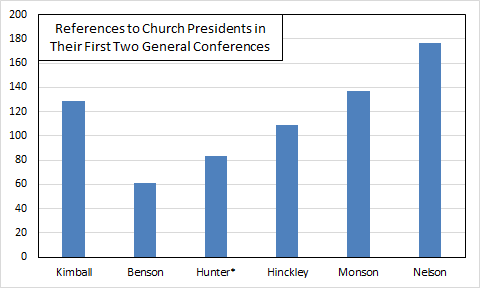
In a comment here at ZD last year, Leonard R suggested that it seemed to him that speakers in Conference have become more prone recently to refer to or quote the President of the Church in their talks. Now that President Nelson has two Conferences under his belt, I thought it might be interesting to look at how often recent Church Presidents were referred to or quoted in their first two Conferences.

I used the ever-handy LDS General Conference Corpus. I looked up references to each new Church President’s last name only (to be sure I wasn’t missing any mentions where he was referred to as simply President [last name] rather than in the usual way, as our beloved prophet and leader, even President [first name middle initial last name]). Since this is just a first pass, I didn’t even check through the results to be sure I wasn’t accidentally including references to other Nelsons, Monsons, Hinckleys, etc., although I suspect that if such references do occur in the data, they are likely to be few.

Here are the results.

I’ve put an asterisk on Howard W. Hunter because he was only President for one Conference before passing away. One solution to this might have been just to double his references, but I decided against doing this because I suspect there is probably a dropoff between a new President’s first and second Conferences.

Anyway, this doesn’t actually get at Leonard R’s question terribly well because we typically have a new Church President only once a decade or so, but the trend for the last few Church Presidents certainly does look hopeful. Perhaps when I have more time, I’ll come back to this question and look at it in more detail.

Abandoning the Quest for a Positive Attitude: Thoughts on Hope

At the residential crisis place where I landed a few weeks ago, we had occasional groups. One day, we did some basic mindfulness practice. Mindfulness is very trendy right now, but I’ve found it to be useful, and don’t mind (see what I did there) going over the basics again. As part of the exercise, they had us look out the window and just observe something for a little while. We then reported back on the experience. I was fascinated to note that everyone in the group except for me, with no prompting to do this, didn’t only talk about the experiencing of observing; they turned it into an inspirational message. For example, they saw the dead leaves on the trees, but realized that there was new life underneath. Or they noticed how a tree continued to grow despite obstacles. I found myself wondering—are people in other cultures this well-trained to relentlessly find inspiration in everything?

In most of the psych wards I’ve been in, they have you rate your mood every day on a scale of 1 to 10. I struggle with the quantification aspect of this, but usually do my best to accurately assess how I’m doing. One day I looked around at the papers of the people sitting around me, and saw that they’d all marked 10. I was mystified. I mean, you don’t get into a psych ward without being in fairly significant distress. Such a rating might have made sense if a person had been hospitalized during a manic episode, but that was clearly not the case for any of the people there that day. My guess was that they were reporting high numbers in an attempt to get released, which is usually the primary goal of people who are locked in a psych ward, but I also wondered whether it was connected to cultural expectations about making the best of everything and having a positive outlook. There’s a certain virtue in circling that 10. Sure you might be having a complete psychological breakdown, but you wouldn’t want to not be positive about the situation. In another group in the residential place I mentioned above, I listened to a fellow patient share that he knew that he could accomplish anything if he would just put his mind to it. The group leader enthusiastically agreed. I realize I’m probably overly cynical—it’s taken me much of my life to realize that it’s not necessarily delusional to try to stay generally upbeat, and that relentlessly negative people can actually be pretty exhausting—but it’s hard for me not see this sort of thinking as problematic. Because the dark side of the equation is that if you haven’t accomplished something, no matter how unlikely that thing may be, it’s because you just didn’t put your mind to it. Read More

[Lesson Outline] Women and Gospel Learning In the Home

President Eyring’s Women And Gospel Learning In the Home talk, from October’s General Conference, has been a popular pick for RS lessons over the past few months, at least judging my social media activity. Up until recently, I was a Relief Society teacher, and I chose this talk for my lesson in November. I’m sharing my lesson outline below, with some commentary in case it helps anyone prepare to teach or participate in a class based on this talk.

Read More

Evensong

When I was in the hospital a few months ago, I missed church on Sunday. Obviously I didn’t have a lot of choice in the matter; I have yet to see a psych ward that would let you out for a few hours to catch a church service. (They’d probably be especially nervous about Episcopal services, come to think of it, with all those candles.) But I was a little surprised at how sad I was to miss even one week. Since I’d walked into my local parish in February 2017, thinking at the time it was just for a temporary change of pace, I had not gone a single Sunday without attending Episcopal church somewhere. Even when I turned into a somewhat manic church-hopper later that year, and tried to visit at least one new church every Sunday, the possibility of skipping Episcopal services was simply never even on the table. It had become too much an essential part of the rhythm of my life.

That Sunday in the hospital, I tried to look on the bright side—I’d been wanting to see a religious service in the psych ward, and indeed I got to go to one. It was very low key. A chaplain came and had a small group of us read a few things, and then talk about them. The predictable result was that we spent a lot of time listening to the not always coherent thoughts of two patients who always had a lot to say. I was sorry I didn’t get a chance to talk to the chaplain more; she was warm and thoughtful, and seemed like an interesting person. I definitely appreciated her efforts. But I also thought about how only a mile away, my parish was holding its usual Sunday services. It was a blunt reminder of how much you’re cut off from the rest of the world in a place like that. The next Sunday, when I walked into church, being in the familiar building again actually made me emotional.

Read More

Mormon Titles, Very Slightly Revised

I’ve seen threads on Reddit where people slightly alter movie titles to completely change what the story is about. I thought this might be an entertaining thing to try with some Mormon-related book and movie titles. This post has my attempts. Please add yours in the comments if you are willing.

The Work and the Gory — This series tells a dramatized version of early Mormon history, with special focus on the Danites.

Read More

Writing in Crayon: A Night in the ER

I’m in a hospital room with almost nothing in it. A bed, with a single blanket and pillow. A chair. One of those narrow little tables you can pull over the bed, where they put meals. They let me keep two paperback books, and my notebook. I’m glad I remembered to get a notebook before we went to the ER. I asked my brother if he happened to have anything around without any wires, and he found me an old green composition book. 100 pages, college-ruled. That should last me, I hope.

I ask if I can have something to write with. Sometimes they let you have plastic pen-like things. I saw a box of them once, and it said that they were for maximum security prisons. Sometimes instead they offer pencils. In one hospital I was in, I got frustrated with the regular pencils, which were those tiny golf-sized ones, and started writing in colored pencil instead. One of the other patients got mad when she saw me doing it, because she felt that the colored pencils should only be used for coloring. She took coloring very seriously.

The nurse says that he can get me a crayon. This is new; I’ve never been to a place that didn’t allow either pencils or pens. I say, okay. He asks what color, and I say that black would be best, but I’ll take whatever they have. He comes back with a black crayon. It’s at least new and sharp, though of course the sharpness doesn’t last long. After a while it breaks in half, making it even more difficult to use it for writing. It’s slow, and tedious. For a person used to typing, which I imagine is pretty much all of us these days, any kind of writing by hand can feel slow, but doing it in crayon is definitely an extra challenge. I find myself only writing on every other line in the notebook, because I can’t write very small. It’s easy to smear the letters, so I have to not rush, and take my time with each letter. But for all that, it’s good to be able to write. No matter how bad it gets, I’ve learned over the years, it helps me deal if I can just put it into words somewhere. Read More

Nacle Notebook 2018: Funniest Comments

This post is my annual compilation of the funniest comments I read on the Bloggernacle last year. In case you missed them, here are links to compilations from past years: 2017 2016 2015 2014 2013 2012 2011 2010 2009 2008.

Most of what I’m quoting here is excerpted from longer comments or posts. I’ve made the commenters’ names links that point back to the original source in case you want to read more. I’ve put the comments in roughly chronological order.

Em, in her post “Mercia Second Ward” at the Exponent:

Recently a remarkable cache of documents has been discovered that shows just how much medieval saints resembled modern day wards! . . . . The moment [the ward librarian’s] back was turned some breezy teacher would waltz in to make a few copies, ignoring the “library demons only” sign on the scriptorium  and wouldn’t you know it, the parchment would get stuck or start unravelling uncontrollably.  Oh look, there it goes again.  “This is so typical,” she thought as she heaved a giant tome of “church illustrations volume 7” onto the checkout desk.  “At least I get to miss Sunday school and talk with my friend.”  Despite its drawbacks, the Ward Librarian was a plum job even back then.

Read More

Is there more temple attendance since the changes?

I’ve heard anecdotally in discussion on Facebook that people attending the temple since the changes in ordinances that came to light last week have found it much more crowded than usual. This seems like it shouldn’t be too surprising. That changes were coming was rumored at least in December, and I’m usually not the most plugged in to such things, so if I heard rumors in December, other people probably did long before that. Given the typical sameness of the temple from one visit to the next, people might be extra interested to go to see when they know it will be different. Add to that the fact that the changes may make the temple more palatable for feminists and other egalitarian-minded folks (although many also understandably feel deeply ambivalent about them), and a whole swath of people who might be on the fringes of temple attendance might want to return.

But of course what I’d love to have is some hard data to see if I can find evidence that this is really happening. Of course I don’t have actual temple attendance data, but what I do have that might serve as a very rough proxy is counts of the number of endowment sessions in each temple. I got these by looking at the individual temple pages on the Church’s site, all linked from this page that lists all the temples. Counts of sessions aren’t as good as counts of temple patrons, but the reality is that there’s zero chance that I’ll ever get anything like that, so I’ll just be happy with what I do have. Even more fortunately, I started taking monthly samples of endowment session counts in the middle of last year, so I have a little bit of past data to compare to. I haven’t counted all sessions for every day in each month, but what I have done is pick two days in each month–always a Saturday and the following Tuesday near the middle of the month–and count sessions on those days. (I chose Saturday and Tuesday because they’re the beginning and end of the temple week.)

This graph shows the total number of endowment sessions across all temples on the two sampled days for each month from April of last year to this month. (Note that the sampled days for this month haven’t even occurred yet; I’ve tried to take session counts in the week before the sampled days so I can get the most up-to-date information if the folks at the temple decide to make a late addition or deletion of a session.)

The total number of sessions looks pretty flat across time. It looks like January has a little dip from December rather than an increase. So, no evidence for the idea that temples are busier?

Not so fast! The situation is complicated by the fact that the totals are not coming from a constant set of temples. New temples open. Old temples are closed for renovation and then re-open later. Every temple (I think) is closed periodically for a few weeks at a time. This last issue means that I couldn’t just solve the problem by showing counts only for the set of temples that were open constantly through the entire period.

Read More

Are the changes in the temple meaningful?

In the psychology of perception, there’s the idea of a just-noticeable difference (JND) in some stimulus. For example, if a person is looking at a light, a JND is the smallest change in light that they’ll notice.

Some of the discussion around the changes that were just made in the temple ceremonies has made me think that we could define a parallel idea for how meaningful a change is: a just-meaningful difference (JMD). A JMD would be a change in something that’s just small enough to be meaningful.

To me, the changes the Church just made are far, far beyond the JMD threshold. The fact that women’s and men’s covenants are now parallel to each other rather than having women covenant to hearken to their husbands and men covenant to obey God is, I think, huge. The hearken covenant (and its even harsher predecessor, the obey covenant) have been the source of so much pain to so many Mormon women over the years. Similarly, the changes that have Eve no longer be silenced for the latter part of the endowment, and dropping the requirement that women be veiled are also very big. All these changes signal a fundamental reorganization of how women and men are though of being in relation to God. Instead of a hierarchical view where God presides over men, and men preside over women–one that Paul and Brigham Young would have preferred–we’ve taken some steps toward one where God is over all, regardless of their gender.

Read More

The Night Before Smithsmas

Twas the night before Smithsmas, when all through the house
Not a creature was stirring, not even a mouse;
The manuscript sat on the table with care,
In hopes that the translator soon would be there;

The children were nestled all snug in their beds;
While visions of stick pulling danced in their heads;
And mama in her ‘kerchief, and I in my cap,
Had just settled our brains for a long winter’s nap.

When out on the lawn there arose such a clatter,
I sprang from my bed to see what was the matter.
Away to the window I flew like a flash,
Tore open the shutters and threw up the sash.

The moon, it was casting a pillar of light,
And I shielded my eyes from the heavenly bright
When what to my wondering eyes did appear,
But a self-propelled sleigh with four men drawing near

Read More

Sheri Dew and the Unimagined Unknown

A few weeks ago, the Church News ran a story about Russell M. Nelson being interviewed by an Argentine journalist. The real headline is captured better by this LDS Living story with a great clickbaity title: President Nelson’s Incredible Response When a Journalist Asked If the Church Excludes Women.

“Many churches are ruled by men, at the exclusion of women,” said Mr. Rubin. “Is this the case for The Church of Jesus Christ of Latter-day Saints?”

“Well,” said President Nelson, “you should talk to a woman about that.”

President Nelson then turned and looked at Sheri Dew, executive vice president of Deseret Management Corporation, the CEO of Deseret Book Company and former Relief Society general presidency member.

“Can you help with this answer about the role of women in the Church?” he asked her. He motioned her into camera range.

Sister Dew told Mr. Rubin that he would have a hard time finding a church where more women have more authority than in The Church of Jesus Christ of Latter-day Saints.

“There are hundreds of thousands of women, right now, who have legitimate leadership opportunities and expectations. As women in the Church we teach and preach, we expound doctrine, we serve missions as full-time proselyting missionaries, and we have leadership responsibilities,” she said.

She thinks he would have a hard time? Seriously?

Read More

Good, Good, Good

When I started school at BYU, back in the 1990s, the school used to celebrate the day before Thanksgiving by bringing a bunch of wrecked cars onto campus and leaving them in various quads to remind us all to drive safely if we were traveling for the holiday. This wasn’t an issue for me, because my family lived nearby, but I recall thinking that if the university had really been serious about students’ safety when traveling over the long weekend, they would just close the day before Thanksgiving to make it easier for people to travel without having to make dangerous overnight drives.

I was reminded of this when reading President Oaks’s talk in the Women’s Session of this last General Conference, where he lamented that Church members are marrying later and having fewer children. He said that people are delaying marriage “until temporal needs are satisfied.” I think he’s making the same error that the BYU administration of the 1990s was making: he’s oversimplifying complicated situations where people face competing goods. BYU students of the 1990s, wanted to attend their classes and do well in school, but they also wanted to go home and see their families for Thanksgiving. Young people in the Church today likely do want to get married and have children, but they also face (in the US, anyway) runaway education costs that mean they’ll be paying for their own schooling for decades, high medical costs that make it ever more difficult to bear and raise children, and high child care costs that make it more difficult for both spouses to get all the education they can. It has often been observed on the Bloggernacle that the Church’s admonitions to marry young, have lots of kids, get all the education you can, and stay out of debt are impossible to satisfy all at once unless you have the good fortune to have been born into wealth.

Read More

What President Nelson’s Talk Tells Us about Decision-making in the Q15

President Nelson stirred up a lot of discussion with his Conference talk, “The Correct Name of the Church,” where he explained that the use of nicknames like “Mormon” for the Church or its members are a victory for Satan. As many people have pointed out (for example, Jana Riess), the arguments he made were similar to ones he made in an earlier Conference talk almost 30 years ago. As a relatively junior member of the Quorum of the Twelve, he found his arguments didn’t gain much traction, as President Hinckley gave a talk in the very next Conference where he embraced the use of the term “Mormon.” This time around, though, he’s in the top spot in Church leadership, so he’s getting things done. The Mormon Tabernacle Choir has been renamed the Tabernacle Choir at Temple Square, for example.

One thing that really struck me about the comparison that shows that this issue has been on President Nelson’s mind for decades is what it reveals about the decision-making process in the First Presidency and Quorum of the Twelve. The D&C says that decisions made by these bodies must be unanimous. If this rule is followed, it means that then-Elder Nelson must have been on board with unanimous decisions made that followed President Hinckley’s approach of embracing and owning the term Mormon. It also means that all the Q15 members who were also on board with President Hinckley’s (and Monson’s) strategy have all changed their minds together, and are now on board with President Nelson’s view.

Read More