Ardis Parshall, who you probably know as the author of the Mormon history blog Keepapitchinin, is planning to write a history of the Church told through the lives of women. She is asking for support through a Kickstarter campaign. I believe this is important work because I think the book will serve as a great counterweight to the overwhelmingly male-narrated and male-focused histories we currently tell in the Church. I hope it will help both women and men to have a broader vision of what women have done in the Church, and as consequence a broader vision of what women might be doing now and in the future. I have made a pledge, and I’m posting to ask you to also consider pledging. For a pledge of $10 or more, you’ll get a copy of the ebook version of the book, and for a pledge of $25 or more, you’ll get a hard copy.
Showing all posts by Ziff
Placement of Scriptures vs. Conference in Menus at LDS.org
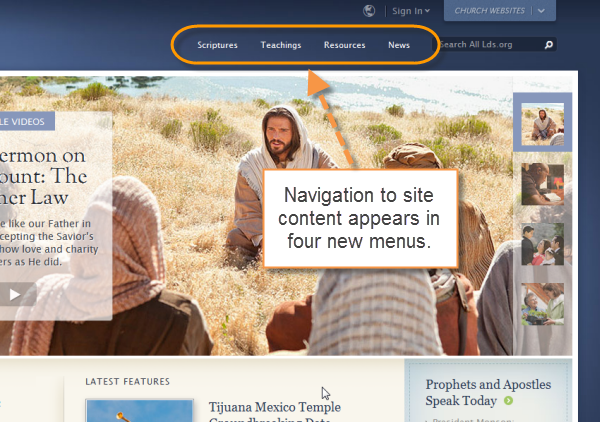
Last week, the Church rolled out a redesigned version of the navigation menus at lds.org. The new menus rearranged links to parts of the site in order to make it easier for site visitors to find what we’re looking for.
One change in particular that seems unrelated to usability caught my eye, though. In the old menus, scriptures appeared in their own menu, and General Conference was in a menu labeled “Teachings.” Here’s a screenshot that shows the old menus. I’m sorry it doesn’t show General Conference under “Teachings,” as the old menus aren’t available anymore so I can’t take a new screenshot. I’ll just have to ask you to trust me that it was there. Also note that the callout calls the menus “new” because this image is from 2012, when the old menus were introduced.
A Look at Conference Speakers’ Favorite Verses of Scripture
I thought it might be fun to look at which speakers in General Conference are most fond of quoting which particular verses of scripture. If you’re thinking you’ve seen me blog about this before, you’re right. It’s just that in my previous posts, I’ve only looked at the level of book of scripture, but now I’m getting all the way down to the verse level. I apologize in advance; I don’t have any interesting hypotheses to examine here. This is another post where I’m just looking at some data descriptively and saying, “Isn’t this cool?”
I took scripture reference data from the LDS Scripture Citation Index. I used the current version of their site and not the new beta version because it was easier for me to pull data from the current version. Unfortunately, this means that what I have is only updated through 2013. The Conference data begins in 1942.
The table below lists the top five verses cited for speakers in Conference since 1942. I’ve limited it to showing top fives for two groups of people: Q15 members who have at least 500 total verses cited, and female auxiliary leaders who have at least 100 total verses cited. Many of the speakers have a tie in their #5 spot, so I’ve extended the table to show all tied verses, except in a few cases where it would have made the table ridiculously long (e.g., Julie B. Beck has a 25-way tie at #5). I’ve also included a brief quote or summary note on each verse to help jog your memory for verses that are less well-known, and I’ve linked each verse reference to the scriptures at lds.org so you can go read them in full if you’re interested.
Predicting Who Will Be Church President: Fit of Actuarial Mortality Table to Historical Data
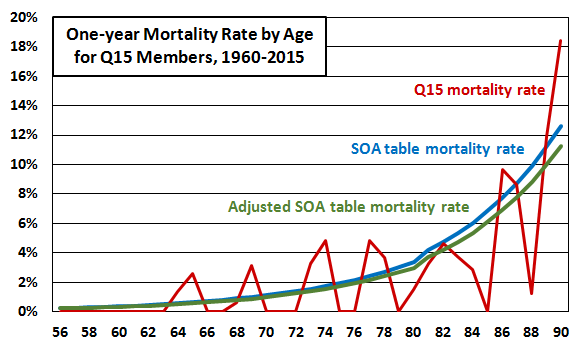
Last month, I wrote a post where I used a mortality table and the current ages of the First Presidency and Quorum of the Twelve to see who among them would be most likely to become Church President. One question that was raised on the post and in some Facebook discussions was how well that mortality table matched up to historical mortality rates of Q15 members. In this post, I’ll try to answer that question.
I looked at historical data from January 1960 to April 2014. Each month1, for each current Q15 member, I noted two pieces of information: his age at the beginning of the month, and whether he was still living one year later. When I aggregated all the data together, they made an empirical mortality table. For any age that at least one Q15 member during that time period lived to, the proportion of such members who died within one year was the empirical mortality rate. Of course, there’s more data for the table at some ages than others, as few Q15 members during this time period were as young as their forties, but many have been in their sixties, seventies, and eighties.
Here’s a graph showing the mortality rate for Q15 members (in red), along with the mortality rate for the Society of Actuaries mortality table I used (in blue). I included only ages for which I had at least 120 person-month observations (or 10 person-years).
Could President Uchtdorf Become *President* Uchtdorf?
After I wrote last week about the probability of each of the members of the Q15 becoming President of theChurch, a few people asked specifically about President Uchtdorf’s chances. And I share their interest. I have found him to be a big breath of fresh air, and I would love it if he did become President.
So what would it take for President Uchtdorf to become President Uchtdorf? Here’s a chart showing a little information for him and all the Q15 members senior to him.
| Quorum member | Rank | Birth year/mo | Age | Prob Uchtdorf outlives |
|---|---|---|---|---|
| Monson | 1 | 1927 Aug | 87 | 84% |
| Packer | 2 | 1924 Sep | 90 | 88% |
| Perry | 3 | 1922 Aug | 92 | 91% |
| Nelson | 4 | 1924 Sep | 90 | 86% |
| Oaks | 5 | 1932 Aug | 82 | 71% |
| Ballard | 6 | 1928 Oct | 86 | 80% |
| Scott | 7 | 1928 Nov | 86 | 82% |
| Hales | 8 | 1932 Aug | 82 | 74% |
| Holland | 9 | 1940 Dec | 74 | 48% |
| Eyring | 10 | 1933 May | 81 | 69% |
| Uchtdorf | 11 | 1940 Nov | 74 | N/A |
Verses of Scriptures Most Often Quoted in Conference
Which of the Ten Commandments gets quoted most often in General Conference? In this post, I’m going to look at some lists in the scriptures (like the Ten Commandments, the Articles of Faith, etc.) and show the relative popularity of the items in the list in terms of how often they’ve been quoted in Conference.
As I so often do, I got data from the LDS Scripture Citation Index to answer this question. They have data from Conferences from 1942 to 2013. Unlike with my other recent posts using their data, I took data not just at the level of book of scripture, but all the way down at the verse level, which of course was required to allow me to look at comparisons between individual verses.
So let’s get started. Which of the Ten Commandments is cited most? (For simplicity, I just looked at references to Exodus 20, and not to any other places in the scriptures that the Ten Commandments appear.)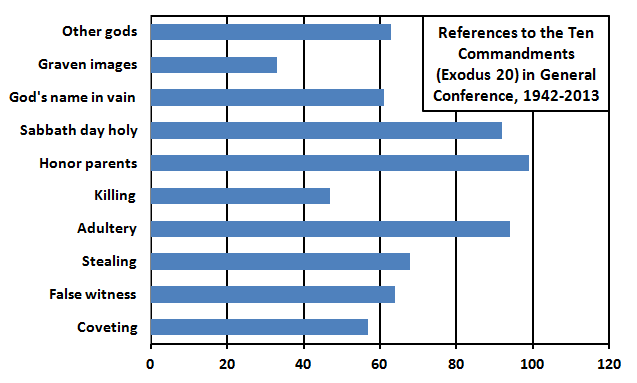 Read More
Predicting Who Will Be Church President (Now Continuously Updated!)
Update: Now that Elder Perry has died, I have replaced the continuously updated table and graph with static versions that show the probabilities as of May 2015. I will write a new post with continuously updated probabilities after his replacement is called in October.
Who among the current First Presidency and Quorum of the Twelve is mostly likely to eventually become President of the Church?
Which GAs Prefer Which Books of Scripture? (Take 3)
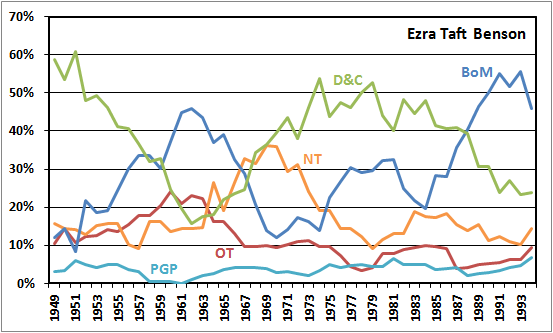
This post is a follow-up to my post last week, where I looked at how much members of the First Presidency and Quorum of the Twelve (Q15) quote from each of the five books of scripture in the LDS canon in their Conference talks. In the previous post, I showed one breakdown for each Q15 member, aggregating his citations of scripture in all his Conference talks, across whatever period of years he served in the Q15. In this post, I’ll show trends across time for each individual Q15 member. The previous analysis would miss it if a GA changed over time from preferring the Book of Mormon to preferring the New Testament, for example. This analysis might be able to show such changes (if they’re large enough). As for the previous post, my data source is the LDS Scripture Citation Index.
The graphs below show seven-year moving averages for the percentages of citations each Q15 member took from each book of scripture. There’s nothing special about seven years for the moving average. I chose it by eyeball. The year-to-year data often jump around a lot, which isn’t surprising given that for Q15 members who aren’t in the First Presidency, one year’s worth of Conference talks is typically just two talks. Seven years of aggregation looked like a good compromise that smoothed out the yearly variation but didn’t smooth so much that it made changes over time disappear. One other note is that I’ve only made graphs for members who have at least 16 years of data. This allows for 10 years worth of seven-year moving averages to be shown (because the first six years are combined into the initial seven-year moving average).
Graphs for Q15 members are shown in the order they were called, which is the same ordering I used in my previous post. Also, to make it easier to look back and forth between the two posts, I’ve used the same color to represent data for each book of scripture as in the previous post. One warning with these graphs is that the scaling of both the horizontal and vertical axes changes from person to person to best display each Q15 member’s data, so be careful if you’re looking at comparisons across graphs.
Which GAs Prefer Which Books of Scripture? (Updated!)
I wrote a post last year that looked at which books of scripture members of the First Presidency and Quorum of the Twelve (Q15) quote from most in Conference. In an article published last week, Peggy Fletcher Stack briefly referred to my work in a discussion of the Book of Mormon taking priority over the Bible in Mormon thought. She specifically talked about the influence of Ezra Taft Benson, and it occurred to me that it would be easy to expand my post from just looking at the living members of the Q15 to including past members as well, so we could actually see what President Benson’s numbers looked like. In this post, I’ll look at which books of scripture members of the Q15 back through Spencer W. Kimball quoted most in Conference. Unfortunately, I can’t go farther back than that because the LDS Scripture Citation Index, from which I’m pulling data, only goes back as far as 1942, so Q15 members called before then have incomplete data. President Kimball was called to the Q15 in 1943, so he is the oldest member for whom I have complete data. Read More
Three wards enter. Four wards leave.
My ward is getting divided this Sunday. Or as you can probably guess from my title, it’s not actually a straight-up split of my ward. It’s that I’m in one of three wards that will have its boundaries realigned, and the result will be four new wards.
 I’ve been through this process only twice that I remember. One time was when I was about sixteen. My family had lived in the same place for eight years or so, and I was felt pretty comfortable in my ward. Between the time that the realignment was announced and the release of the actual details of who would end up in which ward, I remember being extremely worried about having the ward split cut me off from my best friends in the ward. As I recall, the change ended up making very little difference, at least to me. All my best friends were still in my ward after the split. And in retrospect, it’s kind of odd that I was that concerned. I lived in Utah Valley and the ward was geographically tiny, so even if my friends had been divided away from me, I could have still easily walked the short distance to their houses to visit them.
The other ward division I recall going through was just a couple of years ago, when my wife and I lived in a college town that had two wards that were realigned to make three. I was less worried than I had been as a teen, but I still recall worrying that the people I liked most in the ward would end up split away from me. Again, for me the outcome was very little change. All the people I liked most stayed in the ward with me.
What strikes me about the process of ward boundary realignment is that I know so little about it. The process of how such things come about is pretty much completely opaque to me. So what I’d like to do is pose a few questions about the process and speculate a little about the answer to each, and then hope you, dear reader, will be so kind as to share any knowledge you have in the comments.
Do you do apology?
The following is an imagined conversation between Kate Kelly and Dallin H. Oaks.
Do you do apology?
We do not do it, Kate Kelly!
We do not do apology. Read More
Aging of the First Presidency and Quorum of the Twelve
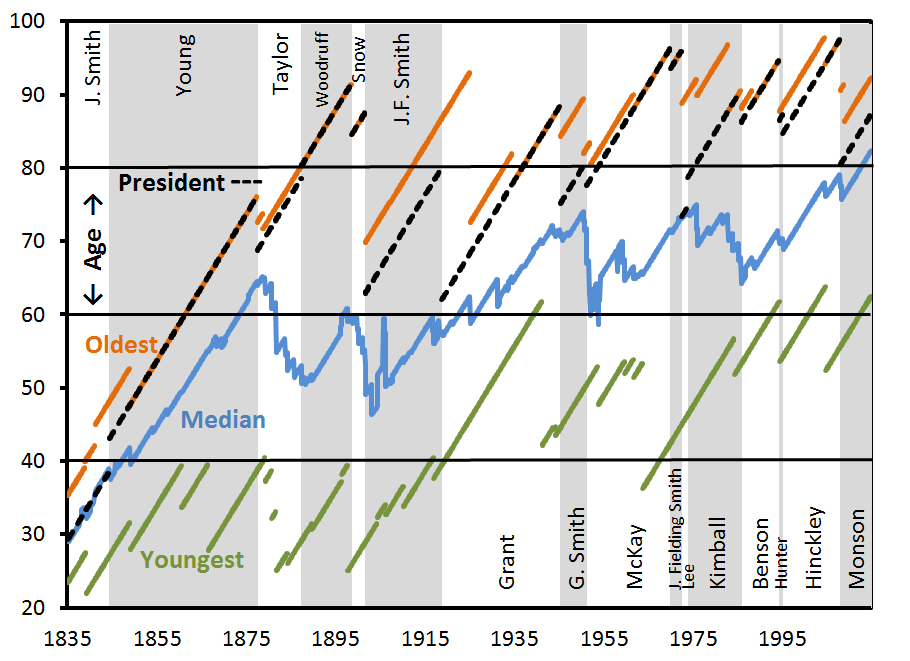
The median age of the members of the First Presidency and Quorum of the Twelve (Q15) is currently about 83. Even for a group that’s often thought of as being old, this is unusual. In fact, the Q15 is older now than it has ever been before.
Here’s a graph showing the age of the Q15 since 1835. The blue line shows the median age. The orange lines show the age of the oldest Q15 member; the green lines show the age of the youngest. The dashed black line shows the age of the Church President. The data come from ldsfacts.net.
Hymns Sung Most Often in General Conference
Which hymns are sung most often in General Conference? My impression is that the Mormon Tabernacle Choir is always opening Conference with “The Morning Breaks,” and every other congregational hymn is “Redeemer of Israel,” but I’ve never actually looked to see if that’s true.
Nacle Notebook 2014: Funny Comments
This post is a list of some of the funniest comments I read on the Bloggernacle last year. (Here are links to collections from previous years, in case you enjoy this one and haven’t seen them before: 2013 2012 2011 2010 2009 2008.)
Most of the quotes are excerpts from longer comments. Also, I’ve made a small change from previous years: this time in addition to comments, I’ve included a few post excerpts, in cases where the excerpts can be appreciated as standalone comments. I haven’t included any of the many funny posts I’ve read that were funny end-to-end, since excerpting from such posts would mean losing the context and the full effect of the humor.
I’ve made each commenter’s name a link to the original so you can go read them in their full glory and original context if you wish. I’ve put the quotes in roughly chronological order.
Porn Preaching Patterns
In her post last week on Mormon fixation with small issues at the expense of larger more important ones, Jana Riess pointed out that the majority of all references to pornography that have ever been made in General Conference have occurred just since the turn of the millennium. I thought it might be interesting to look at the data in a little more detail, because it was my impression that discussion of porn might be declining.
I looked up the yearly rates of usage of the word “pornography” in General Conference at the LDS General Conference Corpus site. Here’s a graph showing the yearly rates and the five-year moving average. The graph starts in 1959 because that’s the first year pornography was mentioned in Conference.
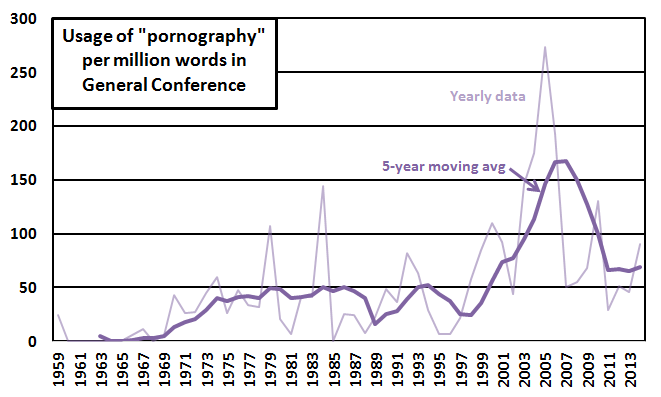 It looks like usage might have flattened out again after a big bump in the 2000s. I would guess that the big bump occurred as the internet grew and internet porn grew with it. I wonder if its usage then declined again because no one issue can be the hot topic forever. Maybe something like gay marriage took its place as the topic of the moment.
A Correlated Mormon Gender Issues Survey
It has come to the attention of the Church Correlation Department that a so-called group of so-called academics has undertaken to do a so-called survey on so-called gender issues among so-called members of the so-called Church. As internet information (including surveys) does not have a truth filter, the Correlation Department has undertaken to edit the survey so that it may be more faith promoting, and less tainted by the philosophies of (wo)men.
Please tell us a little about how you heard about this survey. Who referred you to it?
- The Holy Ghost whispered to me that I should take it.
- The Three Nephites exhorted me to take it while they were changing my flat tire.
- The spirit of a just man made perfect appeared to me and made known unto me that I must take it. I know that I was not deceived, as he refused to shake my hand.
- Other.
Of course your name is on the records of the Church of Jesus Christ of Latter-day Saints. On which other organizations’ records is your name also recorded? (Mark all that apply.)
- The Republican Party
- The Church of the Firstborn
- The Quorum of the Anointed
- The Council of Fifty
- The Lamb’s Book of Life
What is your eternal gender?
- Presider
- Nurturer
How active are you in the Church?
- Fully active
- Fully active, but struggling with being less active
Joseph’s (First) Wife, Emma
How would you describe Emma Hale’s relationship with Joseph Smith? They were married, so she was his wife. But now that the Church is being somewhat more open about Joseph’s polygamy, shouldn’t we be a little more accurate and describe Emma as Joseph’s first wife?
This question occurred to me while reading BHodges’s post at BCC where he lists a bunch of references to Joseph Smith’s polygamy in Church sources. He points out that of course he’s not listing Church source references to Emma and Joseph that do not mention Joseph’s polygamy, because they’re much more common than the references that do talk about polygamy. I thought it might be interesting to go back and look at some of these sources, though, to see if Emma is ever referred to as Joseph’s first wife. More generally, I wanted to look at these sources because even though we know in a general sense that they’re probably numerous and that they probably gloss over or ignore Joseph’s polygamy, seeing the particulars might give us a better sense of just how common they are and how much glossing and hiding they do.
Most Liked Conference Talks (Now with better data!)
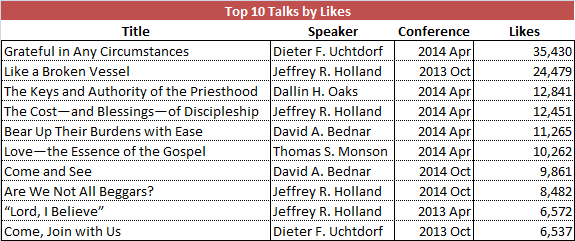
I wrote a post last year in which I tried to assess which Conference talks were most liked by Church members. The method I used was very much a kludge: I looked at the change in Facebook likes for each speaker during the session in which he or she gave a talk. Fortunately, a friend pointed out to me that there’s a much simpler way to measure this. The individual web pages for each Conference talk have a count of how many people liked the talk itself on Facebook. So of course this was data that I was interested in going back to look at.
The Facebook like buttons were added to all Conference talks, going back to 1971. Beyond a couple of years ago, of course, there aren’t many likes since most old Conference talks (other than a few classics) probably aren’t referred to all that often. I might go back later and look at the older talks, but for now I was just interested in the Conferences recent enough that someone could hear a talk in Conference, and then later in the week look it up on lds.org and click like, so I limited myself to 2012 through 2014–the last six Conferences.
There are three things to note about the data. First, I got the like counts a couple of days ago, so they’re already out of date. Second, for like counts over 1,000, the like button shows a count in thousands. I got exact counts by querying Graph Search directly. (I found this on stackoverflow somewhere, but now can’t recall where. The method is to point your browser to the URL http://graph.facebook.com/?id=<URL of talk>.) Third, the like counts for the most recent Conference are lower than for previous Conferences, probably because it has only been a few weeks since Conference occurred, and people haven’t had lots of chances to re-read or re-hear a talk and go back and like it.
Here are the ten most liked talks from the past six Conferences.
The Correlated Story of Zelophehad’s Daughters
It has come to the attention of the Church Correlation Department that many of the stories told in the Bible have not passed Correlation review prior to being included in the scriptural canon. Rather than go through a lengthy and complex process of decanonization, the Correlation Department has undertaken to simply rewrite the unreviewed stories to smooth off the rough edges. The resulting stories will preserve the gospel truths present in the original, but will remove the false philosophies of men that have been inserted by evil and conspiring scribes.
Our first rewritten scripture story comes from Numbers 27.
Then came the daughters of Zelophehad to petition Moses. For their father died in the wilderness, and had no sons. They desired that Moses bring their cause before the Lord, that perhaps the inheritance of their father might pass unto them. And these are the names of the daughters of Zelophehad: Mahlah, Noah, and Hoglah, and Milcah, and Tirzah.
But Nadab spake unto them, saying, Surely Moses shall not consider such a small matter. And he turned them away.