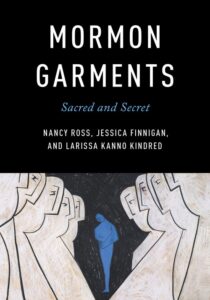
I recently read a fascinating book titled Mormon Garments, authored by Nancy Ross, Jessica Finnigan, and Larissa Kanno Kindred. I’ve read discussions of temple garments on the Bloggernacle over the years, and I’ve run into a lot of discussions of issues that I, as a man, had just never run into. This book does a great job of pulling together a whole host of these issues around garment wearing, many of which were still new to me, relying largely on a 2014 survey the authors did of over 4500 Church members about their thoughts and experiences with garments.
 The book opens with a chapter on the history of temple garments. I learned a bunch here, like the fact that garments were originally “progressive and innovative underwear in the nineteenth century” and only later, like post-World War II, became an instrument of modesty enforcement. If I have it right, there weren’t even separate designs for women and men until the 1950s, and the Church hadn’t even fully taken over production of them until a decade or two before. I was also surprised to learn that a Church committee in the 1930s made a recommendation that garments be made sleeveless, which was rejected at the time, only to finally be implemented in just the last few years.
I was struck by how haphazard the Church’s treatment of garments seems to have been across time. This was particularly underscored by the point the authors made that a 1997 talk by Carlos E. Asay, a Seventy, “became the main source for contemporary church teaching about garments.” This just does not strike me as a well-planned or well-thought-out approach to articulating a coherent explanation for the whats and whys of garment-wearing. He wasn’t even a Q15 member, but apparently he just happened to be the only one willing to say anything explicit about them? This totally tracks, though, with the recent talks by, for example, Dallin H. Oaks, on the topic. As I recall, there were some whispers beforehand that he was going to address the garment wearing in his 2024 talk, so I was curious to see how explicit he would be. Not very, was the answer. His comment on when it’s okay to not wear garments was pretty much just this: “we are instructed to wear temple garments continuously, with the only exceptions being those obviously necessary.” Those obviously necessary? This wording just screams someone who doesn’t want to get into any detail for fear of embarrassing his audience or himself. It’s no wonder that Elder Asay’s talk has stood so long as a reference.
The bulk of the book, then, is based on analyses of the responses of the people who took the survey. The authors break their respondents down into four groups based on gender and belief. They label belief as conforming for those who firmly believed in the Church’s teachings, and nonconforming for those who expressed doubt about any of them. Then they also break down their questions into different categories that the chapters focus on, so there are chapters titled “Secrecy and Sacredness” (reporting answers to questions about how wearing garments makes them feel and why they wear them), “Shame and Worthiness” (with questions like what respondents were taught at Church about their bodies, and what their garments mean to them), and “Obedience and Control” (where the authors discuss respondents’ answers that relate to their experience with the relationship between garments and sexuality).
As you know, I’m a stats guy, so of course if I had the data the authors did, my inclination would have been to try to come up with a coding scheme for all the responses so I could put them into neat buckets and crunch some numbers on them. I thought what they chose to do was far more effective, though. In each section, they have a separate subsection for each gender/belief group and they discuss broad themes that they saw in the responses, but then they quote the individual respondents. I found the respondents’ comments sometimes remarkably powerful. It was so cool to hear people’s thoughts directly in their own words. Here’s just one example of many I liked. A nonconforming woman is talking about stopping wearing her garments:
Without the garments my clothes fit better. My mind is off my body.
I just find her second line so pithy and spot on, as for so many women in the survey, wearing garments require them to be constantly monitoring their clothes and their body. And the pattern is true over and over that garments are clearly far more of a hassle, or straight up a pain, for women than for men. This is not only true because they’re more compatible with common men’s clothing styles, but also because of women’s experiences menstruating, being pregnant, and breastfeeding while trying to wear them, that we men don’t have to navigate.
The authors also interject their own experiences with the temple and garments and temple recommend interview questions throughout the book. I thought this was an excellent way for them to be upfront about their own biases, and also to add some even more in-depth personal experiences to the book. For example, near the beginning of the book, Nancy tells her story of going to the temple for the first time and being eager to learn whether it would be okay to wear her bra under her garments. The harsh response she got from the temple matron was flabbergasting! (Check out the book for the details.)
In addition to the personal experiences, I so much appreciated the authors’ clear-eyed statements of what garments are and how they’re functioning among Church members. Here’s an example of an analysis that just seemed so spot on to me:
Modesty and sexual purity teachings in the LDS Church contributed to a central paradox at the heart of understanding Mormon bodies: bodies are sacred temples and bodies are dangerous temptations. LDS women consistently reported a hyperfixation on their bodies that stemmed from modesty rhetoric. Women explained that even when they were wearing clothing that was deemed modest by garment standards, they were still adjusting and checking to make sure their garments were not visible. Wearing garments created an ongoing shame-management project in the lives of Mormon women, as the business of adjusting, checking, and self-monitoring of garments was a constant. Complying with modesty standards, then, did not always create feelings of worthiness but often provoked shame, especially from those whose identities have been problematized. Where church teaching emphasized behavior as a marker of worthiness, in practice many understood that their identities brought on feelings of unworthiness.
(Note that the emphases are in the original, although they appear there as italics. I’ve used bold because our theme has all words in italics in a block quote.)
I think this book should be a tremendous resource especially for people who find wearing garments difficult and who are pretty much told that it’s a test of their faith. Because it makes clear that it’s not an issue of just one person, especially just one woman, who is having a hard time. There are systemic issues with garments that a lot of people face. (For one woman’s related experience, see Megan B.’s recent guest post at the Exponent Blog.) I love that the authors did the survey and wrote the book.
Appreciate this review, it sounds like a book I want to read.
In a random sample of 4500 respondents, there were surely some who reported positive, or mixed experiences. I would be fascinated to hear their perspectives. Does the book delve into those experiences, or at least give some statistics? Can you give a sample of what men and women might have found meaningful and important about garments and what they might have also found challenging?
Anecdotal to this story: while visiting Utah last week, called all Utah locations down to SLC to see if anyone stocked or had in stock petite sleeveless garments. No luck which left me wondering, “How can this be?!?!” I’d seen many women in sleeveless tops so they had to be somewhere.
A week later, I stopped at a SL Valley Deseret Book and ran in. To my surprise, the petite sleeveless tops were in stock. I asked the cashier how this happened. She responded that they usually hold them in reserve (off the shelf) for only newly called sister missionaries. She just happened to put a few extra on the shelf that morning. If you have to endure the heat, the sleeveless tops do help.
Very interesting explanation for the shortage. They’re almost as rare as hens teeth. The closer you get to the SE , the harder they are to find and, with brutally hot weather, they’ve become a necessity across the Southern US.
E, I hope you enjoy it!
Left Field, sure, there were a lot of quotes on positive or mixed experiences. Here’s an example from a woman explaining the reasons she wears garments:
But they don’t give statistics, other than some descriptives in the appendix. The sample isn’t anything like random, so I think their more descriptive approach makes sense.
Another reader, that’s fascinating! The whole roll-out of the sleeveless designs feels very strange to me, with such unequal access!