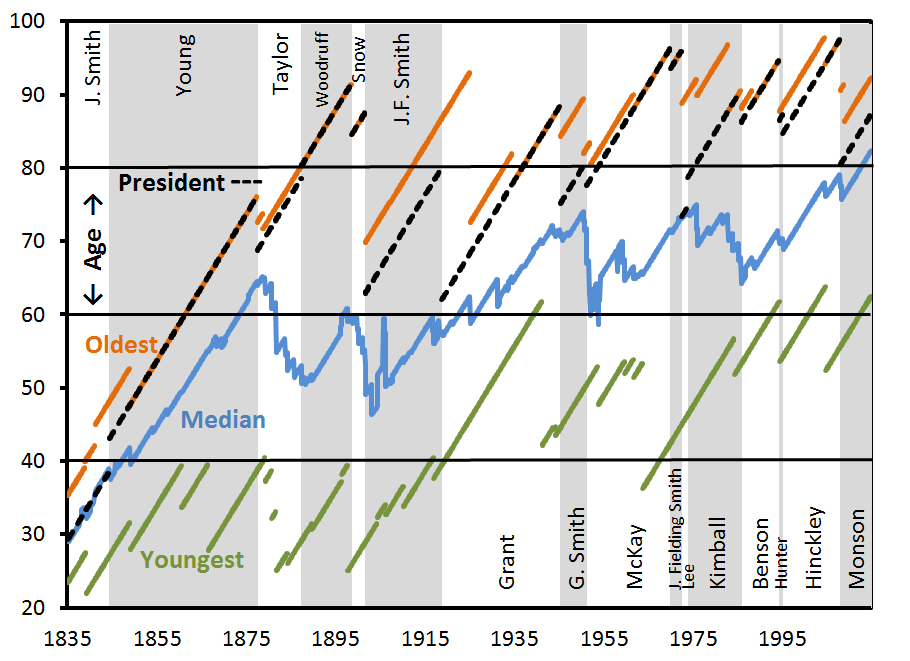
What do patterns in Church practice and patterns in the stories we hear in Church teach us? I was thinking about this question recently after reading the #VisibleWomen series at the Exponent. The question of how patterns teach was brought to my mind because the whole series seems to be built on this idea. The purpose of the series is to make suggestions to Church leaders about ways that women could be made more visible in areas like Church art, in giving talks, and in conducting their own session of Conference. The subtitle explains the reason: “You can’t be what you can’t see.” The suggestion of this line is that patterns of practice in the Church like how infrequently women are portrayed, how rarely Heavenly Mother is mentioned, and how women aren’t even allowed to conduct their own Conference session, are conveying messages to women that are limiting their view of themselves.
I used to be a statistics teacher, and in that role, I often thought about how patterns can teach. One way the issue came up was when I used example data to teach my students about a statistical test. They would sometimes draw conclusions from irrelevant patterns in my examples. For example, if I illustrated use of a test using two examples, one where the data were temperatures in degrees Fahrenheit, and the other where the data were temperatures in degrees Celsius, students might conclude that the test could only be used when the data were temperatures, but not if they were shot put distances or cell phone provider preference ratings or rat body sizes or any other type of data. Or if the data I showed were all rounded to the nearest ten, students might conclude that the test could only be used with data that had been similarly rounded.
I’m not at all surprised that my students did this. People are great at finding and generalizing patterns. The upside of this is that it made teaching easier: students picked up on many real patterns in how different tests could be used without my ever having to state them explicitly. This generalizes far beyond the classroom. Much of what we learn (probably most of it) comes from observing patterns in what other people do, rather than from having people explicitly explain things to us.
What I tried to do with my students to avoid accidentally teaching things I didn’t intend to with irrelevant patterns was to vary the characteristics of my examples as much as possible to break up the incorrect patterns. For example, if I wanted to avoid conveying that a test could only be used for temperature data, I might show one example that used temperature data and another that used something completely different, like elephant tusk length data. If I wanted to avoid conveying that a test required values rounded to the nearest ten, I would show data where values were rounded at different points.
In case my statistics-related examples are too dense, here’s one that might be more straightforward. If I were teaching someone about parts of speech, and I introduced adjectives with the examples “orange,” “blue,” and “green,” it wouldn’t be surprising if the person I was teaching concluded that only colors qualified as adjectives. I would be better off using a set of examples that broke up the pattern I didn’t want to convey, so something like “orange,” “hairy,” and “difficult.”
Getting back to my opening question, there are many obvious patterns in what we do in the Church, and these patterns convey clear messages, even without anything being stated explicitly. I thought it might be interesting to list some of these patterns and briefly outline what they’re teaching. Many of them come not even from our practice but from the types of stories that are taught (in Conference, Church magazines, and in lesson manuals). Read More



 When I was 16 years old, my Utah ward put on a road show. I don’t remember much about the plot, but I do remember that it had a comedy dream sequence that included some dancing circus ballerinas. For some reason none of the young women wanted to be the ballerinas, so my buddy Rich and I volunteered. My mom and other ladies in the ward sewed us full-body ballerina suits, complete with tutus and ballet slippers. As cross-dressing ballerinas, we were the stars of the show.