Quentin L. Cook gave a talk to young adults over the weekend at BYU-Hawaii. Among other things, he discussed online anonymity, which it sounds like he sees as always a bad thing. He said at one point:
One of your greatest protections against making bad choices is to not put on any mask of anonymity. If you ever find yourself wanting to do so, please know it is a serious sign of danger and one of the adversary’s tools to get you to do something you should not do.
He drew a parallel between saying things anonymously online and the KKK putting on hoods to terrorize black and Jewish people, and also mobsters painting their faces when attacking Joseph Smith and Sidney Rigdon.
He actually made a related comment in his Conference talk a few weeks ago:
Any use of the internet to bully, destroy a reputation, or place a person in a bad light is reprehensible.
I think Elder Cook does have a point. There’s an idea in psychology called the online disinhibition effect that describes how people are less inhibited online than they are in person, possibly because of anonymity and asynchronous communication. This can definitely be a bad thing when it enables us to be more hostile and cruel.
But if you read the Wikipedia article I’ve linked, there are also positives to online disinhibition. People might be more able to make self-disclosure about difficult things when communicating with others online, especially when those others don’t know who they are, so they can speak freely.
Moving beyond online disinhibition, I think there’s value in anonymity–especially online–in allowing people to communicate ideas that are outside the mainstream in their group. And you can probably guess, I’m thinking here specifically of Mormonism, and the value I’ve found participating in the Bloggernacle. I remember when it was first new, and commenters would frequently show up on the big blogs and take the bloggers to task for just talking about the Church or the scriptures or the GAs in a non-devotional tone. In contrast, I found it completely liberating to be able to talk about Church-related things this way, and to no longer be limited to correlated discussions where everything works out in the end for the righteous, and any questions that can’t be answered are by definition wicked to even ask.
Some of the big blogs, notably BCC and T&S, weren’t and aren’t anonymous, though, requiring bloggers to use at least some form of their real name. I’ve appreciated that they haven’t ever made the same requirement for commenters. And I’ve been happy that here at ZD, I can just be Ziff Zelophehad, which is unrelated to my real name. I think this isn’t actually all that different from the technically non-anonymous bloggers at the big blogs who use initials in part or in whole to obscure their real names. I assume the bloggers who do this have the same types of motives I do: I don’t want what I write online to be easily Googleable and connected to me. But not because I’m up to something nefarious, as Elder Cook would suspect, but rather so I can keep enjoying this non-correlated discussion without accidentally dragging ward members or extended family into it. I am active in my ward and I love my extended family, and they largely know I’m a heretic and accept me anyway, but it could be made more difficult for them if they went online and found me discussing my heresies at length. I suspect it’s easier for them to accept me while my heresies are more an abstract idea rather than particular concrete heretical blog posts.
I sometimes participate in discussion of Mormonism (and of other topics) online on other sites at opposite ends of the anonymity spectrum: Facebook and Reddit. Facebook wants you to use your real name. Reddit wants you to make up a screen name, and will assign you one if you don’t make one up. On Facebook, I’m obviously much less anonymous than here, but I don’t think completely non-anonymous. I say that because some of my Facebook friends I’ve never met in real life, so even though they do know my name and whatever I post, there’s no real-life me to connect this knowledge with. On Reddit, I feel like I’m even more anonymous than here on the blogs. I hardly ever recognize other people there from one interaction to the next. This contrasts strongly with here, where I know hardly anyone in the sense of knowing real names, but I know many people in the sense of remembering their comments and maybe some experiences they’ve shared. And I assume that many or most readers and commenters feel the same. You might not know my real name, but you probably know what things I like to complain about, and how I love a nice data visualization.
Getting back to online disinhibition, I’m thinking about how I’ve behaved differently when having different levels of anonymity online. At my most anonymous, on Reddit, I’ve definitely said some argumentative things, but I think I’ve been much better at following the dictum that you don’t have to attend every argument you’re invited to. Here on the blogs, I haven’t gotten into many arguments in the past few years, probably at least partly because the audience of ZD has been whittled down to people who have at least some sympathy for what I write. In the early years of the Bloggernacle, though, and probably through at least Ordain Women’s heyday, I got into a lot of long arguments that were in retrospect pretty ridiculous. Nobody was ever convincing anyone else of anything, and coming back over and over with new reframings and examples and analogies didn’t change that. I was far too convinced of my ability to convince other people to agree with my views to let arguments go easily. At my least anonymous on Facebook, I’ve definitely argued less, but this is I think largely attributable to the fact that I hardly ever post publicly, and mostly just interact with my friends. And if people are rude to me, I unfriend or block them. My experience with different levels of anonymity on these sites is also confounded with the order in which I encountered them, which is blogs, Facebook, Reddit, so if I’m doing any better at not behaving badly on Reddit than on the others, it might just be that I’m a tiny bit older and wiser.
Anyway, I agree with Elder Cook that anonymity can be a facilitator of bad behavior. What I think he misses, though, is that anonymity is also a tool of the powerless. People in positions of power, like Trump or Musk, don’t need to worry about censoring what they say. They don’t need to hide behind screen names. They can unleash their screeds on the world with no fear of reprisal. The same goes for the GAs, although to be fair, they’re generally less prone to screeds. They have institutional power, the ears of millions, and billions of dollars. They don’t need to worry that anything bad will happen to them if they say something people think is strange or wrong. It’s ordinary people who fear repercussions of saying unpopular things who feel the need to resort to anonymity. I think Elder Cook partly doesn’t like anonymity because he’s in a position of power, and he wants to be able to more easily respond to people who say uncomfortable things, to know who they are if they’re Church-associated so he can punish them. I mean, the SCMC is still a thing, right?
But I’m not saying anonymity by powerless people is always good either. I know that it can be used just as easily by DezNat people to avoid owning up to their attacks on heretics just like heretics use it to hide from them. The fact that the KKK members in Elder Cook’s example had to hide behind hoods is a good thing in that it meant they weren’t in power. Today’s white supremacists are able to be far more bold, sometimes doing things like attack the US Capitol–sans hoods–to try to prevent an election from being certified, which is clearly a step backward.
I think in the end, I agree that anonymity might be bad in what it enables and even perhaps encourages us to do. But I think Elder Cook is too categorical in rejecting it, because I think it sometimes has its good uses too.
I’d love to hear what your experience with online anonymity and non-anonymity has been. Also, please correct me if I’ve misunderstood Elder Cook’s talk. I haven’t watched it. I’ve only read the Church Newsroom article summarizing it, so I might be wrong about what he said.
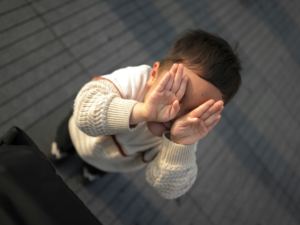
Note: I’m unable to get the links to work in the photo caption. The photo is by alizy xiao on Unsplash.