Fastest hymn: Go Forth with Faith (Saturday morning), All Creatures of Our God and King (Saturday afternoon), Praise to the Lord, the Almighty (Sunday morning), How Firm a Foundation (Sunday morning), and Let Zion in Her Beauty Rise (Sunday afternoon) all felt quite fast to me.
Slowest hymn: If I Listen with My Heart (Saturday morning)
Best hymn: Come, Thou Fount of Every Blessing (Sunday morning). This will probably always be my favorite whenever it’s sung, especially the Mack Wilberg arrangement.
Other good hymns: His Eye Is on the Sparrow (Saturday morning), My Song in the Night (Saturday afternoon)
Worst hymn: God Bless Our Prophet Dear (Sunday afternoon)
Liken the hymnbook to yourself: Henry B. Eyring, in announcing the hymn “His Eye Is on the Sparrow,” called it “My Eye Is on the Sparrow.”
Longest prayer: 148 seconds, J. Anette Dennis, Saturday afternoon benediction
Shortest prayer: 65 seconds, John D. Amos, Sunday afternoon invocation
Longest talk: Tamara W. Runia, 1575 words
Shortest talk: Edward Dube, 902 words
Best titles:
- Tamara W. Runia, “The Sculpting of Our Souls”
- Paul H. Sinclair, “Quick to Help, Slow to Judge”
- Michael A. Dunn, “The Ninety and Ten”
Most footnotes: Hutch U. Fale, 33
Fewest footnotes: Five speakers had zero. All used in-text citations instead.
Longest footnote: Patrick Kearon’s note 10 was 523 words.
Footnote most detracting from a talk’s message: Patrick Kearon’s note 10 was a lengthy quote from Dallin H. Oaks about the danger of spending time with unbelievers. This undermined the hopeful message of his talk about how Jesus wants to lift us up.
Best footnotes:
- D. Todd Christofferson’s references and notes about gambling departed from the Conference norm both in being largely secular and actually interesting.
- Paul H. Sinclair added a lot of commentary in his footnotes, including things like explaining the idiom “going to the well too many times” and reassuring that “it does not apply when speaking of Jesus Christ.”
Most unnecessary footnote: Hutch U. Fale opened his talk by saying “I am a child of God and He loves me,” and cited Henry B. Eyring. If that isn’t the most basic, agreed-upon LDS doctrine, I don’t know what is.
Best stories:
- Paul H. Sinclair opened his talk by telling of a young boy who, while participating in a primary program, managed to button his suit together to create “a one-armed straitjacket.” While he (Elder Sinclair) grew “more and more aggravated” just watching, a fellow primary child helped the boy get out so he could go and speak his part. I especially like that the helper was a girl, flying in the face of patriarchal stereotypes.
- Kevin J. Hathaway told about a missionary whose father died just a week before she was to return home. She told him later of how she had clung to her faith during the period, but she wasn’t made miraculously joyful in the face of the death of a loved one like in other stories sometimes told in Conference.
- Rosemary K. Chibota told of how as her daughter was finishing time in a school, the janitor approached her and her husband to tell them how kind she had always been to him, when most of the kids never noticed him.
- I liked the story Edward Dube told about Dallin H. Oaks seeing a sign on a mission office that said “Trespassers will be prosecuted” and asking for it to be removed so that nobody would feel unwelcome.
- Thabo Lebethoa told a story of how he and his wife had their first argument shortly after being married. He never went back and wrapped it up with a neat bow or said they never argued again or similar nonsense. I appreciated how real this felt.
Worst stories:
- Vaiangina Sikahema told of how his grandparents traveled for days between Pacific islands and even had one of their children die, just so they could “sit at the feet of an Apostle.” This sounded way too worshipful to me.
- Neil L. Andersen told about how when Dallin H. Oaks was a busy young attorney, he accepted a calling to be a counselor in the stake mission presidency. I don’t like the story because it sets a bad example for people who need to set boundaries around their engagement with the Church and also because it’s clearly Elder Andersen sucking up to President Oaks.
Stories that Russell M. Nelson would never have permitted to be told if they had been about him:
- Timothy L. Farnes told about how, after an exhausting day, he met Dallin H. Oaks in the temple, and Elder Oaks said something encouraging to him. Years later, he met again with him and Elder Oaks didn’t remember having met him before.
- Gary E. Stevenson shared a drawing of him a primary-aged Conference watcher had shown him, and the artist had not even spelled Elder Stevenson’s name right!
Best lines:
- Tamara W. Runia: “But what if you had a beautiful story you thought your life was going to tell, and instead you’ve had to surrender that story? That sting is real, and that wound is wide.” I appreciate her acknowledgement of real suffering and the fact that life often doesn’t go how we plan.
- Sean Douglas: “You are what you preach.”
- Dale G. Renlund: “The power of the Messiah to save and exalt is profoundly intimate and infinite beyond human comprehension; there is more than enough to cover any breach, need, or deficit for all of us, for each of us.”
- Timothy L. Farnes: “when someone encounters us, they should experience something of Jesus Christ—His kindness, His patience, His hope, His love, His compassion.”
- Edward Dube: “We do not need to perfect ourselves to come to Christ. We come to Christ to be perfected.”
- Dallin H. Oaks: “We are all a work in progress.”
- Dieter F. Uchtdorf: “In the Savior’s Church, it is not our political views, culture, or personal interests that unite us. It is our love for God and neighbor, God’s children.”
- Paul H. Sinclair: “[A] true disciple of Jesus Christ is quick to help and slow to judge.”
- Paul H. Sinclair, speaking of Jesus and the woman at the well: “He did not hold her hostage to her history.”
Worst lines:
- Henry B. Eyring: “The combination of trials and their duration are as varied as are the children of our Heavenly Father. No two are exactly alike. But what is being tested is the same, at all times in our lives and for every person: Will we do whatsoever the Lord our God will command us?” No, President Eyring. The purpose of life is not for us to become ever-more-obedient bots. How about if instead we develop some sense of right and wrong within ourselves?
- Quentin L. Cook: “Any use of the internet to bully, destroy a reputation, or place a person in a bad light is reprehensible.” Sure, this is sometimes bad and misdirected, but other times, people are actually bad and it’s a good thing to call this out.
- Gabriel W. Reid: “Some may ask, ‘How can I teach everything in 25 minutes?’ Perhaps the better question is ‘How can I help those I teach connect to the Savior sooner?'” Please can we just stop with this Bednarian approach of restating people’s questions into what we wish they had asked?
Funniest lines:
- Tamara W. Runia: “I’m also good at stain removal. I see it as a challenge; in fact, some have referred to me as ‘the stain whisperer.'”
- D. Todd Christofferson: “It [a prediction market bet] could be tied to anything: interest rates, elections, sports, wildfires, or even, if you can imagine, the timing of the Second Coming. (Where would you go to collect on that bet?)”
- Dale G. Renlund, after telling of a heart transplant patient complaining about his oatmeal being cold: “I don’t think anybody should be tortured with oatmeal regardless of temperature.”
- Michael A. Dunn was exhausted near the end of an ultramarathon when his friend and fellow runner Ted encouraged him with a “Ted Talk.”
Worst attempt at a funny line: Gerrit W. Gong: “Why did the temple workers cross the road? To help the people on the other side.”
Lines missing an asterisk:
- Ulisses Soares: “Though our fast offerings may seem small and simple, they become consecrated expressions of compassion, concern, and service.” *Since the Church’s 2012 change to tithing slips, they may redirect any donated funds however they see fit, so our consecrated expressions of compassion, concern, and service may be converted into capital for the Church to expand its stock portfolio or real estate empire.
- Sean Douglas: “God held you in reserve for this time.” *The reference is to a 2018 talk, so it’s unclear if God held people in reserve for 2018 or 2026. Or, for that matter, for the 1980s when I was a teen and heard the same line. Or the 1950s when my parents did.
- D. Todd Christofferson, quoting Dallin H. Oaks: “The act of taking or trying to take something from someone else without giving value in return is destructive of spiritual sensitivities.” [italics are Oaks’s] *Future Conference talks will presumably condemn business ventures such as gyms and app subscriptions that also attempt to extract an ongoing stream of money from people without providing anything in return.
- D. Todd Christofferson (in his note 4): “[F]inancing [social] benefits through the sale of lottery tickets represents, in effect, a regressive tax borne largely by those who can least afford it.” *Like tithing.
- Quentin L. Cook: “Young people who attend For the Strength of Youth and young single adult conferences often tell me the testimony meeting, a small portion of the event, is the most appreciated.” *The young people I talk to tell me they prefer the dances.
- Dallin H. Oaks, quoting 2 Nephi 26:33: “he denieth none that come unto him, black and white, bond and free, male and female” *Since 1978 on the skin color. Full acceptance of women still pending.
Line needing a copy editor: Kevin J. Hathaway, in telling a story about a car accident his family got into, explained, “While driving in a construction zone, two large tires came loose from a semitruck and struck both cars at high speed.” Like me, you can probably hear your junior high English teacher asking in exasperation, “Were the tires driving in a construction zone?”
Surprisingly self-aware line: Ronald A. Rasband talked about how members engage with family members who have left the Church: “We preach, cajole, argue, demand, lecture, ignore, sit them down to watch general conference, and even send them links to the talks, like this one, but to no avail. If anything, these efforts can cause a greater rift.”
Best line to get on Kristen M. Oaks’s bad side: Gérald Caussé: “Your testimony may be different from mine or that of other family members or fellow Saints.”
Best line to get on Harold B. Lee’s bad side: Thabo Lebethoa: “Ultimately, the method, timing, and length of our scripture study matter less than the consistency and sincerity of our effort.”
Best title to get on Russell M. Nelson’s good side: Ulisses Soares: “A Higher and Holier Fast”
Best line to get on Ronald A. Rasband’s good side: Sean Douglas told a story of a pair of missionaries who served as companions together twice, “by divine design.”
Best line to get on Spencer W. Kimball’s good side: Michael A. Dunn: “the Redeemer rescues not by shortening our course but by helping us lengthen our stride.”
Best line to get on James E. Faust’s good side: David A. Bednar: “God promises His sons and daughters supernal blessings for honoring covenants”
Best line to get on Ezra Taft Benson’s bad side: Rosemary K. Chibota: “Years ago I prayed to know how I could help a coworker who seemed isolated. As I acted on simple promptings to include him, our friendship grew.” Not only was she working for pay, she was befriending a man!
Best line to get on Trumpists’ bad side: James G. O. Fantone: “The Savior’s invitation is not merely for us to add His name to our name like a badge of religious affiliation.”
Best topic to get on Trumpists’ bad side: Christian C. Chigbundu talked about COVID as a “global health crisis” that “claimed millions of lives” rather than a left-wing conspiracy to discredit the Dear Leader.
Best term: “Arc of discipleship,” Dieter F. Uchtdorf. I know it sounds kind of adjacent to “covenant path,” but at least it’s fresher.
Worst terms:
- “Spiritual credentials,” David A. Bednar. This just feels too much like he believes in a transactional God.
- “Eternal increase,” Dallin H. Oaks. I know this is in the D&C. To me it has connotations of polygamy, of men as gods and women as eternal harem members.
Best non-scripture quotes:
- Kevin J. Hathaway quoted Patrick Kearon: “Jesus specializes in the seemingly impossible. He came here to make the impossible possible, the irredeemable redeemable, to heal the unhealable, to right the unrightable, to promise the unpromisable. And He’s really good at it. In fact, He’s perfect at it.”
- Ulisses Soares quoted Joseph Smith: “A man filled with the love of God, is not content with blessing his family alone, but ranges through the whole world, anxious to bless the whole human race.”
- Timothy L. Farnes quoted Patrick Kearon in his note 7: “Often, during the sacrament, we think about how we did at keeping the commandments during the previous week. That kind of self-reflection can be good. But a covenant doesn’t just look back; it looks forward. It’s not so much about what we’ve done in the past; it’s more about what we’re willing to do in the future—in Christ’s name and with His help.”
- Jeremiah J. Morgan quoted Jeffrey R. Holland: “You have not traveled beyond the reach of divine love. It is not possible for you to sink lower than the infinite light of Christ’s Atonement shines.” [italics are Holland’s]
- Ronald A. Rasband quoted Thomas S. Monson: “Never let a problem to be solved become more important than a person to be loved.”
- Neil L. Andersen quoted David O. McKay: “The greatest battle of life is fought within the silent chambers of your own soul.”
Worst non-scripture quotes:
- Patricio M. Giuffra quoted Russell M. Nelson: “tithing can break cycles of poverty in poor nations and families. We preach tithing to the poor people of the world because the poor people of the world have had cycles of poverty, generation after generation . . . That same poverty continues from one generation to another, until people pay their tithing.”
Best scripture quotes:
- Matthew J. Eyring quoted 1 Corinthians 2:9: “Eye hath not seen, nor ear heard, neither have entered into the heart of man, the things which God hath prepared for them that love him.”
- Neil L. Andersen quoted 2 Corinthians 4:8: “troubled on every side, yet not distressed; … perplexed, but not in despair.”
- James G. O. Fantone quoted Mosiah 2:17: “When ye are in the service of your fellow beings ye are only in the service of your God.”
Worst scripture quote: Vaiangina Sikahema quoted D&C 1:38, “whether by mine own voice or by the voice of my servants, it is the same” [emphasis is his] and seemed to imply that this meant Joseph Smith’s words were exactly God’s.
Lines from speakers gunning to take Neal A. Maxwell’s position as the alliterative apostle:
- Gerrit W. Gong referred to “a world of commotion, contention, and cares.”
- Kevin J. Hathaway testified that “the Lord is not delayed, distracted, or derelict in His deliverance.”
- Michael A. Dunn referred to himself as “both depleted and defeated” near the end of running an ultramarathon.
- Neil L. Andersen mentioned “the doubts, distractions, and deceptions of our day.”
Unafraid to refer to the monstrosity that is D&C 132:
- David A. Bednar
- Gerrit W. Gong (see his notes 9 and 10)
The dictionary defines ____ as:
- D. Todd Christofferson actually did a great job of explaining opportunity cost, although he didn’t give any indication that it’s a commonly discussed idea in economics, instead citing Dallin H. Oaks as his source.
- Dale G. Renlund explained what oatmeal is in his note 3.
- Patrick Kearon explained what a glider is.
- Michael A. Dunn cited the Bible Dictionary to explain what grace is.
- Ronald A. Rasband, in his note 6, explained immortality and eternal life.
- Ciro Schmeil referred to the Church Handbook to explain what a covenant is.
- David A. Bednar defined both a covenant and an ordinance.
Variety in Bibles:
- Hutch U. Fale told a story of reading a Bible when he was young, and in a footnote, mentioned that it was a Gideon Bible.
- Ronald A. Rasband in his note 2 mentioned how a phrase was translated differently in the KJV and the New American Standard Bible.
- Paul H. Sinclair referred to the NIV twice in his footnotes.
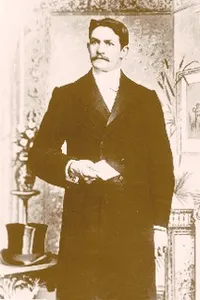
Best picture: Quentin L. Cook shared this photo of David O. McKay as a mustachioed missionary.
Good patterns:
- There were only 10 mentions of Russell M. Nelson (plus 34 in footnotes), markedly down from the numbers he used to get when he was leading the Church. I assume he’s in the afterlife somewhere seething about being forgotten.
- There were 43 mentions of Dallin H. Oaks (plus 48 in footnotes), which seems like a lot, but (without checking) also not quite Nelson-like numbers.
- With a little less focus on quoting the current prophet, speakers seem to have rediscovered previous prophets, with multiple references to Spencer W. Kimball (Henry B. Eyring, Rosemary K. Chibota, Quentin L. Cook, Dallin H. Oaks), David O. McKay (Quentin L. Cook, Neil L. Andersen), and Thomas S. Monson (Alfred Kyungu, Neil L. Andersen).
- A few male speakers even remembered they could quote women: Clark G. Gilbert cited a story told by J. Anette Dennis, and Thabo Lebethoa quoted Tamara W. Runia. (There may have been more that I missed.)
- Former mission presidents appear to now always refer to their service with their wives as serving as “mission leaders.”
- Like in last Conference, talks were shorter (average of 1200 words vs. 1600 in 2025 Conferences) to fit the three dozen or so speakers into four sessions. I think there are potential downsides to this, like that it might prevent speakers from getting into much depth in their topics. But really, hardly any talks were that deep before, and so far, I find the talks easier to read and I feel like shortening them is a net positive.
- Multiple speakers—Tamara W. Runia, Kevin Hathaway, and Matthew J. Eyring—talked about trials without sugarcoating them or telling unlikely stories about people who were filled with joy even after their loved ones had died.
- Surprisingly, two speakers—David A. Bednar and Dallin H. Oaks—admitted to limits of doctrinal understanding. President Oaks referred to “the sometimes incomplete teachings of religion.” Elder Bednar was even more explicit. When discussing situations where one spouse remains in the Church while the other leaves, he says the remaining spouse will still get all their promised blessings, even though “The revealed doctrine of The Church of Jesus Christ of Latter-day Saints does not address all details of and nuances about such cases.”
Bad patterns:
- How can we have not one but two talks about tithing, and a bonus one that gets into fast offerings, when the Church is so drowning in wealth that the GAs don’t know what to do with it? I know they think that paying tithing is a blessing, but the reality is that, especially for many people living in poverty, it is a curse. All it would take is one kind Church president to reframe tithing in some way to reduce the burden and millions of faithful Church members would benefit. But instead we get this horrifying drumbeat of reminder of the need to pay up.
- Multiple speakers, for example Quentin L. Cook and Alfred Kyungu, talked about the need to be kind in our speech and online interactions. This is a nice and useful reminder. But it’s also the type of reminder that is used by people in power to suppress raising of issues by people not in power. “You’re being contentious and that’s of the devil,” they can tell them, citing talks like this.
- Multiple speakers, for example Rosemary K. Chibota and Hutch U. Fale talked about the need to reject worldly labels and consider ourselves only children of God. I appreciate the desire to see us all as equal before God, but this type of language is often a coded call for LGBTQ people to not think of themselves as LGBTQ, but rather as struggling to be straight and cisgender. It also seems adjacent to the “I don’t see color” response to racism being pointed out, so we pretend that everyone is happily accepting of each other and nobody has different cultures or experiences based on gender, sexuality, or race differences.
Thanks for gender neutralizing:
- Sean Douglas, in his talk calling for people to serve missions, had only one paragraph where he quoted Russell M. Nelson about missionary work being a “priesthood responsibility” for men, but “optional” for women. Other than that, he made no indication that he was talking more or less or differently to men versus women. In his rewriting of Thomas B. Marsh’s mission call to be directed to anyone, where it opened by calling him “my son,” he added “[or daughter]”.
- Dale G. Renlund quoted Moroni 10:3, which asks the reader to remember the Lord’s mercy “unto the children of men from the creation of Adam . . . until the time that ye shall receive these things.” Renlund retained “children of men,” but replaced the Adam-only phrasing with “[throughout the ages]”.
- Quentin L. Cook paraphrased the American Declaration of Independence, which he said “highlights the premise that all are created equal,” when of course the original says “that all men are created equal.”
Thanks for mentioning heavenly parents (but of course still following the Church style guide and not capitalizing them):
I’m sure it’s not a coincidence that it was only women referring even obliquely to Heavenly Mother.
What wasn’t said:
- Quentin L. Cook referred to the idea that happiness is the purpose of our existence, but rather than quote Joseph Smith’s infamous polygamy pressuring happiness letter, he quoted David O. McKay as saying something very similar: “Happiness is the purpose and design of existence.”
- Andrea Muñoz Spannaus told a story of making a list of “virtuous and good things I wanted to have happen in my life” after hearing a lesson about the thirteenth Article of Faith. Having heard about many YW lessons of this type, I feared she’d talk about making a list of characteristics of her future husband, so I was pleasantly surprised when they never came up.
Best talks:
- I appreciated how Tamara W. Runia talked about adversity, and how it’s extra hard when we hear so many prosperity gospel messages.
- Paul H. Sinclair’s message was simple, conveyed in his title—”Quick to Help, Slow to Judge”—but it’s a great message.
- I appreciated Dieter F. Uchtdorf’s message about unity. And I always enjoy when a speaker points out something new I hadn’t noticed before, which he did when he said the sacrament is the only ordinance where the recipients aren’t named (and framed it as a reason for the sacrament to be unifying).
- I appreciated D. Todd Christofferson’s warning about gambling. I’m with him in being appalled at how big it has gotten in such a short time, with people able to use apps on their phones to throw money away in real time.
Surprisingly not bad talks:
- Dallin H. Oaks, for a talk at least partly directed at heretics like me, was surprisingly non-scolding.
- Ronald A. Rasband, for a talk directed at family members of heretics, was refreshingly focused on loving rather than harassing.
Worst talks:
- Patricio M. Giuffra, no more talks about tithing, please. Especially no more talks that quote Russell M. Nelson saying that paying tithing will get people out of poverty.
- Moisés Villanueva, no more talks about tithing, please.
- Clark G. Gilbert, not surprisingly as he’s a disciple of Dallin H. Oaks, also loves the framing of the two great commandments as requiring that you tell people how wrong they are as a way of showing your love for them. No, thanks.
Most muddled talks:
Both tithing talks, in addition to being offensive in their content, were muddled in what they were saying. I think it’s a fundamental problem with how we talk about tithing, where it’s not really supposed to be paid with the expectation of earthly blessings, but then people really expect earthly blessings since the only stories we ever tell about people paying tithing have them receiving earthly blessings. So Elder Giuffra quoted his wife saying that they don’t keep the commandments with the expectation of blessings. But then he couldn’t help himself and he went on to tell of people who once couldn’t afford shoes, but faithfully paid their tithing, and now own successful businesses. So we don’t really expect blessings, but they always come? Really? And Elder Villanueva struggled with the same problem. He was clearly grasping at straws to come up with blessings he had seen from tithing, because if they’re too obvious, then tithing clearly isn’t working or all the best investors in the world would recommend it. So they have to be kind of vague. He lamely asks at one point, “Have you ever asked yourselves whether the Lord has caused your personal possessions to last longer because you have faithfully lived the law of tithing?” Boy, talk about opening the windows of heaven! My shoes last 6% longer now that I’m a tithe payer!
My heretical reviews of past General Conferences:
April 2026
October 2025
April 2025
October 2024
April 2024
October 2023
April 2023
October 2022
April 2022
October 2021
April 2021
October 2020
April 2020
October 2019
Fantastic work – I always look forward to these. Honestly, Gilbert’s talk was off-putting enough that it eclipsed much of the good in the rest of conference. I really appreciate that you remind of the good (I hadn’t noticed the Uchdorf comment on the Sacrament, for example) and also contextualuze the not so good.
Love the General Conference review! Honestly I liked Elder Gong’s joke.