As you no doubt have heard, Russell M. Nelson passed away over the weekend, at the age of 101. A friend messaged me quickly to ask what this meant for probabilities of reaching the top spot for all the other Q15 members, so I thought I’d update the analysis I’ve done periodically.
This graph shows future probabilities for each Q15 member. As when I’ve done this before, I used a mortality table produced by the Society of Actuaries to create it. For details on the method, see the “Method” section of my 2023 post on this question. One update I continued from my 2024 post is to do the calculations for each month in the future rather than for each year. In addition, I fixed an error that DaveW pointed out last year where I was cutting off the calculations too early for the younger Q15 members by only going out 30 years, so this time I went out 60 years even though the graph only shows 30 because that’s the period where most of the action is.
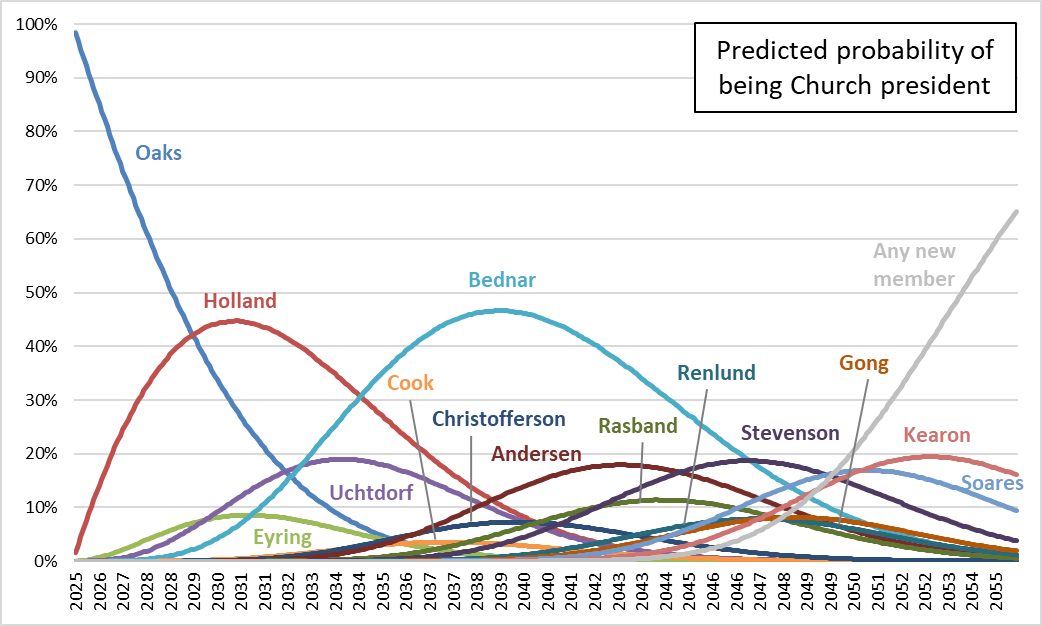
Using the mortality table shows Jeffrey R. Holland and David A. Bednar having high probabilities of becoming Church president. Again, this isn’t news if you’ve read my previous posts, which always showed Oaks, Holland, and Bednar as likely candidates to make it to the top spot. But if you’ve read them for long enough, you also know that Russell M. Nelson never looked like he had a very good chance, so it’s clear you should take these forecasts with a big grain of salt. Thinking along those lines, the mortality table doesn’t know about Elder Holland’s health issues, which might make it more likely than the graph shows that Dieter F. Uchtdorf will get the chance to become President Uchtdorf again.
The graph above shows the probability of each Q15 member being Church president at future points in time, but it doesn’t do a good job of showing the range of possible results. Quentin L. Cook has low probabilities, for example, but does this mean it’s beyond the realm of possibility that he could become Church president? Or could it happen? To answer questions like this, I ran a little simulation using a random number generator and the mortality table to pick 10,000 possible life expectancies for each Q15 member, and then used the logic of succession to determine which of them would get to the top spot and for how long. I also ran the simulation both with and without Russell M. Nelson included so I could see the effect of his death on all other members’ probabilities. This table summarizes the results.
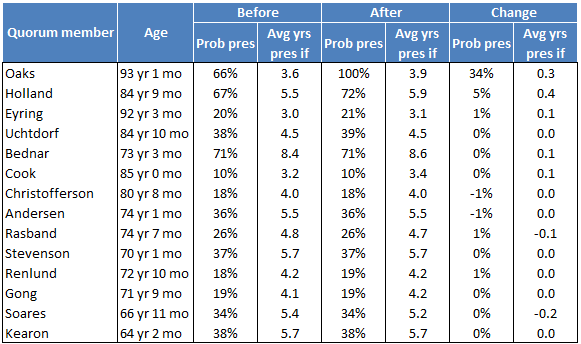
As I’ve noted before when doing this exercise, it’s when a Q15 member dies relatively young, especially when there are other members behind him in succession but close to him in age or even older than him, that probabilities move dramatically. For example, in this old post, see how much Harold B. Lee’s death in 1973 increased the probabilities for Spencer W. Kimball and Ezra Taft Benson (scroll to the third graph in the post). President Nelson was the oldest man in the Q15 and the most senior, so it’s no surprise he was the next to pass, and as the table shows, his death really only affected Dallin H. Oaks’s probability, moving him from likely to certain. Also note that he got a little bump in average years president, as now all the rest of the years of his life he’ll be president, rather than waiting in the wings for some of it. As you move down the table, there’s little change, as these men were already very likely, according to the mortality table, to outlive President Nelson. (Note that the little changes in probabilities for Elders Christofferson, Andersen, Rasband, and Renlund are a result of differences in the random number generation. If I had run for a million scenarios, these would likely show as zero.)
Still hoping for a dramatic announcement of going to emeritus Q12 at a certain age… but thought Nelson could’ve been the one to do that as a doctor and he didn’t. Watching my aging parents and their siblings struggle, it’s hard to imagine the responsibilities we are asking of these aging men.
As you point out, the odds change a lot depending on such factors as current health problems and genetics. President Nelson and President Packer were a day apart in age, but President Packer’s parents died relatively young. President Nelson’s parents lived into their 90s. So he had good genes for longevity. President Packer did not. President Packer also had polio when young. So their lifespans played out as we might have expected. By the same token, President Holland and Elder Uchtdorf are about the same age. But President Holland almost died this past year and is now confined to a wheelchair. Elder Uchtdorf is hale and hearty and likely still skiing and biking. Don’t be surprised if he outlives President Holland by many years. Then again, we really don’t know.
Why do some years repeat, on your graph?
Oh, sorry, that’s a great question, jjjet. The calculation is monthly, but rather than labeling each month in the graph, I put labels only every nine months because it looked like it struck a compromise between being too cluttered and not giving enough information. But then of course every few years, two consecutive dates nine months apart fall in the same calendar year, so the label repeats. I considered putting the year and month in the labels to make it clearer, and maybe I should’ve stuck with that. The next time I do this analysis, I’ll make the labels clearer.
Now of course that peak of years for Holland has become obsolete.
I suppose that a new chart with Elder Causse and the impending incarnation of Elder Anyothermember will follow when Ziff has the time.
It’s interesting to see how much the graph has changed since this posting…Holland’s death made Uchtdorf’s curve surge upwards,while Elder Causse had a brief tenure as most likely in the early 2050s squelched by the addition of Elder Gilbert.
Elder Anynewmember has had to yield nearly a decade before taking the summit.