Church President Probabilities, Changes with the Death of One Q15 Member

After I put up my last post, where I gave updated probabilities of each current Q15 member becoming Church president, a friend asked me if I had ever looked at sensitivity of these probabilities to the death of one Q15 member. So, for example, Russell M. Nelson is 99. If he died tomorrow, this would obviously have a big effect on the chances for Dallin H. Oaks, as he’d become Church president. But what about all the men junior to him? And you could ask the same question about each Q15 member. Like David A. Bednar seems a pretty good bet to become Church president at some point, but if out of the blue, he died tomorrow, how would that shuffle the probabilities for the men junior to him?

I recalculated all the yearly probabilities of being Church president for each of the 14 remaining members of the Quorum, with each current member being removed in turn. I used the same method and same actuarial table as in my last post. For simplicity, I didn’t do any of the health adjustments that I tried in that post; I just stuck with the base case of the unadjusted mortality table probabilities for each man (still depending on age, though).

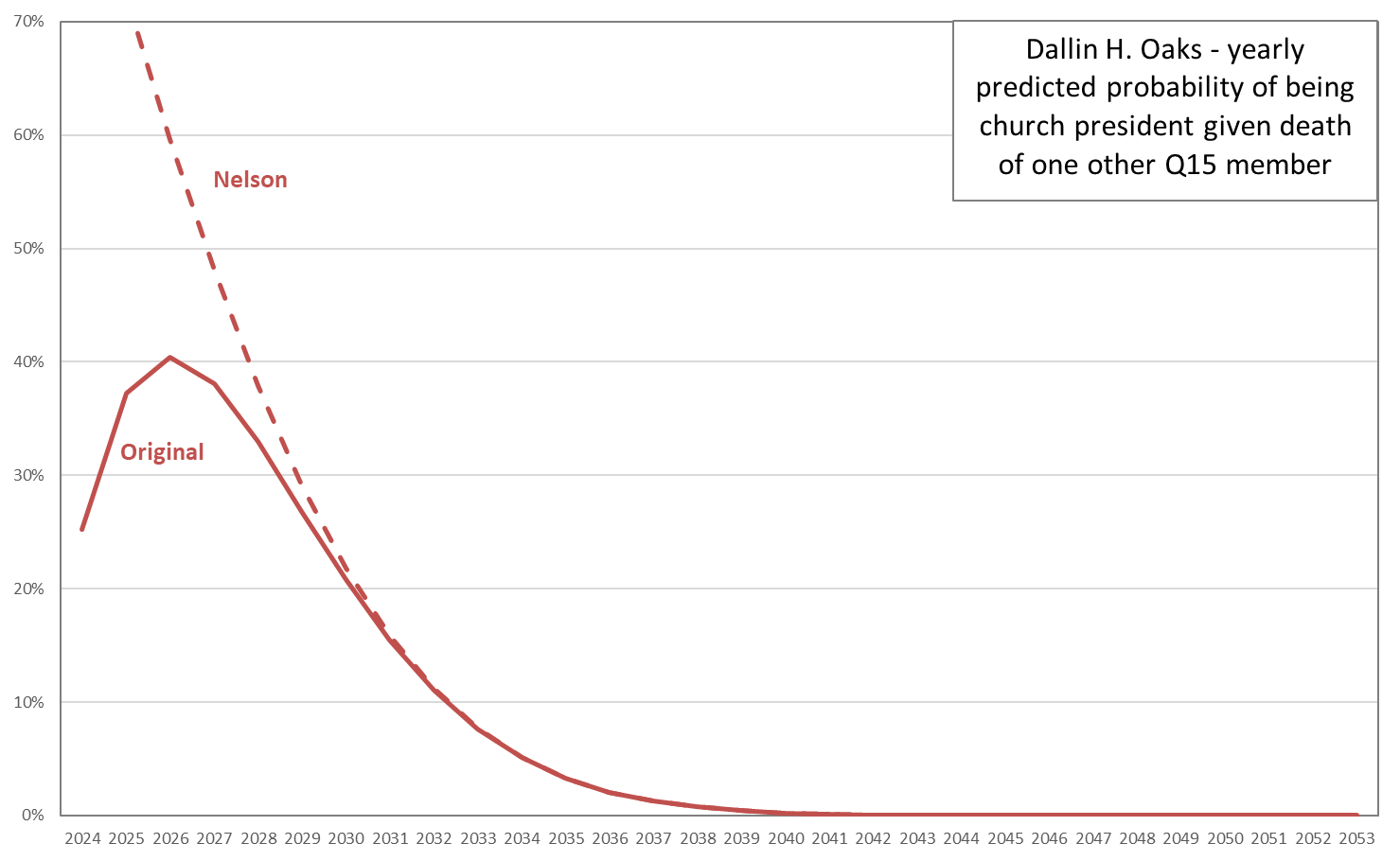
To make the results easier to look at, I’m showing them organized by surviving member rather than by dying member. That is, I have one graph showing all the probability changes for Dallin H. Oaks if someone senior to him died (of course there’s just one man senior to him: Russell M. Nelson) and then another graph for all the probability changes for M. Russell Ballard if someone senior to him died, and so forth. Also, so you can compare the graphs to the ones in my last post, I’m keeping each man’s line color the same as in the last post and also keeping the scale of the Y-axis constant for all the graphs. In each graph, I’m making the original probability curve solid and then making dashed all the probability curves that would result if another senior member died. This might sound too messy to look at, but I think it turns out to not be too bad because the probability curves shift in regular ways, and don’t jump and cross each other all willy-nilly. Anyway, I’m hoping that even if this explanation of the graphs doesn’t make total sense, once you look at a couple of the them, it will be clearer.

There are a couple of other things to note about the graphs. One is that to avoid having the graphs for the more junior members be really cluttered, I’m only showing modified probability curves for a senior member’s death changes the member in question’s probability by at least one percentage point in at least one year. For example, Russell M. Nelson’s death would have a near zero impact on Ulisses Soares’s probabilities, as Elder Soares is already very likely to outlive President Nelson, and his chances of becoming Church president depend much more heavily on the life expectancies of men closer to him in seniority, like Gerrit W. Gong, for example. The other last thing to note is that because I only checked probabilities in yearly steps, pairs of Q15 members who are the same age as of the start date have exactly the same effects on probabilities for members junior to them if they (the members who are the same age) were to die. This means that there are two pairs of members, Jeffrey R. Holland and Dieter F. Uchtdorf (both 82) and Neil L. Andersen and Ronald A. Rasband (both 72), for whom the adjusted probability lines for men junior to both of them are identical, so I’ve just labeled them with both men’s names.

Okay, enough preamble. Here’s the graph for Dallin H. Oaks.
Read More

Church President Probabilities, 2023 update

Who among the Q15 will eventually become president of the Church? This is always an interesting question for a couple of reasons, I think. One is that the members of the Q15, even though they typically present a united front, clearly have different visions for what the Church should be. So it actually matters who makes the top spot and who doesn’t. Of course the most obvious example of this is that Russell M. Nelson was clearly fuming about use of the label “Mormon” for decades, and it was only after he finally became Church president that he could finally impose his idea on the rest of us.

The other reason I think this is such an engaging question is that it seems so tantalizingly tractable! There aren’t a million variables and unknown unknowns to account for. There’s just this very simple succession rule, and this well-defined pool of candidates, and so who gets to become president boils down to who outlives who. And it seems like we should be able to predict that, right? Right??

Of course the answer is no, but it’s fun to try anyway. I looked at this question the same way I have in previous posts (e.g., in 2015, in 2018). On the advice of an actuary friend of mine, I use a handy mortality table (specifically, the part for white collar males, employees up until the series ends at age 80, and healthy annuitant thereafter) provided by the Society of Actuaries. I’ll explain the details at the end of the post if you’re interested, but for now I’ll just say that I can use the table to work out each man’s probability of surviving to any particular future age, and from that and the probabilities of surviving for Q15 members senior to him, his probability of being church president.

When I’ve done this type of analysis before, commenters have asked the reasonable question of whether I couldn’t make an adjustment for the Q15 members’ health. I have had two concerns with trying to do this. First, it’s hard to know how to assign levels of health in any reliable way, and second, even if I did know how healthy each of them were, I’m not sure how to adjust the mortality tables in response.

But in this post, I’m throwing caution to the wind and trying an adjustment. I’m using a very crude health categorization: I’m adjusting mortality rates only for the two Q15 members who weren’t at October Conference in person, namely Russell M. Nelson and Jeffrey R. Holland. I worked around my second concern by trying a range of possible adjustments. I adjusted the yearly mortality rates for President Nelson and Elder Holland by increasing them by 10%, 20%, 50%, and 100%. (Note that it’s really easy to mix up percentage changes and percentage point changes. These are percentage changes. So for example, if a table mortality probability is 3%, then the adjusted rates for the various increases are 3.3% [adding 10% of 3%], 3.6% [adding 20% of 3%], 4.5% [adding 50% of 3%], and 6% [adding 100% of 3%].)

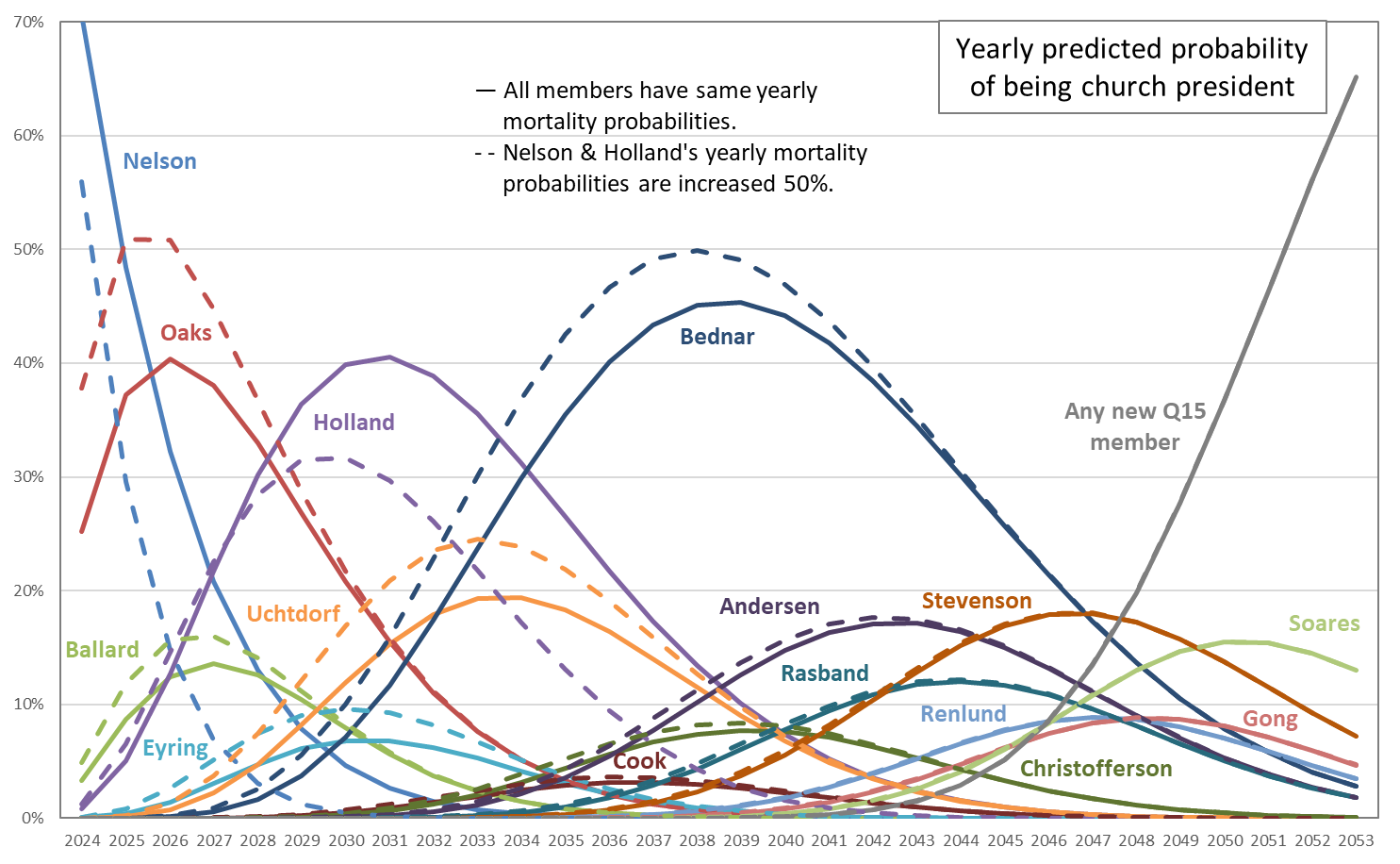
The graph below shows the probability of each Q15 member being church president for each year for the next few decades. The solid lines show the unadjusted probabilities, and the dashed lines show the probabilities with a 50% adjustment.

Read More

A Heretic Reviews General Conference, October 2023

Best hymn: “Come, Thou Fount of Every Blessing,” Saturday afternoon.
Worst hymn: “We Listen to a Prophet’s Voice,” Saturday morning. We can’t seriously claim to believe in fallible prophets while we sing this hymn.
Fastest hymn: “Arise, O God, and Shine,” Saturday evening.
Slowest hymn: “I’m Trying to Be Like Jesus,” Sunday morning.
Best tacit admission that the hymn is too long: The YA choir singing “I Believe in Christ” Saturday evening just skipped verse 2.

Longest prayer: 164 seconds, Michael T. Nelson, Saturday morning benediction
Shortest prayer: 49 seconds, Clark G. Gilbert, Saturday evening invocation

Best title: Robert M. Daines, “Sir, We Would Like to See Jesus”.
Worst title: M. Russell Ballard, “Praise to the Man”. Can we please just not with the prophet worship?
Title that sounds like a threat: Yoon Hwan Choi, “Do You Want to Be Happy?”. Well, do ya, punk?

Good patterns:

Bad patterns:

  • Multiple speakers used threats to get their points across. Dallin H. Oaks and Russell M. Nelson threatened people with lesser kingdoms in the next life if we don’t shape up. Carlos A. Godoy and Valeri V. Cordón warned parents that we’ll lose our children if we’re not devoted enough.
  • Joni L. Koch and Adilson de Paula Parrella felt like they still needed to make a big deal about the correct name of the Church. For Elder Kock, it felt particularly out of the blue, as he was talking about humility, and then brought the topic up as part of a “pop quiz” on humility. What?
  • It’s not good news when multiple speakers (D. Todd Christofferson and Russell M. Nelson) are quoting from D&C 132. Even if they’re not talking directly about polygamy and women as interchangeable objects, you can bet they’re talking about adjacent topics.
  • Two speakers (Yoon Hwan Choi and Gerrit W. Gong) talked about how Church members shouldn’t turn down callings.

Random interesting bits:

  • I appreciated that when he wanted a sports example, Gary E. Stevenson not only went for a sport not popular in the US (soccer), but he talked about women’s soccer.
  • Ulisses Soares compared the many groups of humanity to the Iguaçú Falls in Brazil that come from the Iguaçú River. This makes the second Conference in a row with a Brazilian river analogy, as in April, Dale G. Renlund talked about the pororoca in the Amazon, where the water flows backward under some conditions. I look forward to seeing which speaker will take up the baton and keep this topic going next April!
  • In talking about the afterlife, Dallin H. Oaks gender-neutralized the description of people in the celestial kingdom, quoting D&C 76:58 with daughters added: “they are gods, even the sons [and daughters] of God,” but a few paragraphs later, he didn’t gender-neutralize people in the terrestrial (“honorable men of the earth”) or telestial kingdoms (“he who cannot abide . . . a terrestrial glory” [ellipsis in original]). Honestly, I appreciate that he tried, as it’s often not obvious when scripture writers meant men as people and when they meant it as just men. But I also think this highlights the concern so many women have that they’re really not that important in LDS thought, except as tickets.

Read More