One of the movies produced by the church that I actually rather enjoy is Nora’s Christmas Gift, partly because even though it has its cheesy moments, I like Nora, who is funny and real. But I also appreciate its message, which is one that resonates with me. Nora has to cope with life circumstances that I think most of us would find quite challenging, as age and declining health put her in a position where she finds herself more dependent on others. She has to cope with the unsettling shift from being the person who organized things and offered help to others to being the person in need of help. She quite understandably resents the situation and resists the help. But at the end of the movie, it occurs to her that learning to accept what others offer her—and ultimately what God offers her—is what Christmas is ultimately about: “let earth receive her King,” she says, with a dawning recognition that is it up to her to allow grace to affect her life. Read More
“The Hardest Thing There Is”: Turning to Christ in the Midst of Sin
In his writings, the great reformer Martin Luther, who turned the theological world of the sixteenth century upside down, returned again and again to a very basic problem: how do you believe in the atonement, or grace, or the saving work of Christ, on a personal level? How do you really take in that those things apply to not just humanity in general, and more to the point, not to some category of “good people,” but to a sinner like yourself? “I have often experienced,” he wrote, “and still do every day, how difficult it is to believe, especially amid struggles of conscience, that Christ was given, not for the holy, righteous, and deserving, or for those who were His friends, but for the godless, sinful, and undeserving, for those who were His enemies, who deserved the wrath of God and eternal death.” ((Luther’s Works Volume 26: Lectures on Galatians, ed. Jaroslav Pelikan (St. Louis: Concordia Publishing House, 1963), 36.)) Luther noted that when he found himself consumed by the forces of sin, it was nearly impossible to turn to Christ for rescue and forgiveness. He attributed this at least partly to the work of the devil, whose voice constantly whispered in his ear, reminded him of his unworthiness, and informed him that Christ would surely damn him. He described his experience of being frightened of Christ: “even at the mention of the name of Christ,” he recounted, “I would be terrified and grow pale, because I was persuaded that He was a judge.” ((Ibid., 178.)) Luther also observed the inexorable and unforgiving logic of the conscience: “You have sinned; therefore God is angry with you. If He is angry, He will kill you and damn you eternally.” He went on to even suggest that as a result, “many who cannot endure the wrath and judgment of God commit suicide by hanging or drowning.” ((Ibid., 150.))
The only way to quiet these condemning voices is, of course, to throw yourself utterly on the mercy of the Savior. But Luther was well aware that this is much easier said than done. To turn to Christ, to look for grace, while being assailed by the forces of judgment and condemnation, he observed, was enormously challenging: “to do this in the midst of struggle is the hardest thing there is. I am speaking from experience, for I am acquainted with the devil’s craftiness . . .” ((Ibid., 38.))
Death on a Friday Afternoon
Selections from Richard John Neuhaus, Death on a Friday Afternoon: Meditations on the Last Words of Jesus from the Cross (Basic Books, 2000).
“Christians call them the Triduum Sacrum, the three most sacred days of all time when time is truly told. The fist, Maundy Thursday, is so called because that night, the night before he was betrayed, Jesus gave the command, the mandatum, that we should love one another . . . The second day is the Friday we so oddly call ‘good.’ And the third day, the great Vigil of Resurrection Conquest. Do not rush to the conquest. Stay a while with this day. Let your heart be broken by the unspeakably bad of this Friday we call good . . . let your present moment stay with this day. Stay a while in the eclipse of the light, stay a while with the conquered One. There is time enough for Easter.” (1-2)
“Good Friday brings us to our senses. Our senses come to us as we sense that in this life and in this death is our life and our death. The truth about the crucified Lord is the truth about ourselves . . . The beginning of wisdom is to come to our senses and know that fearful truth about ourselves, that we have wandered and wasted our days in a distant country far from home.” (4) Read More
The Strength of Listening, Letting Things Go, and Even Changing Your Mind Sometimes
Many, many years ago, after an extended argument on a ZD thread in which people complained about the contentious turn that a particular discussion had taken, a commenter opined that this was nothing, and we should visit a particular male-dominated blog known for endless debate to see what “real robust challenge” looked like. I was annoyed, of course, by the subtext that the (often female) participants at ZD couldn’t handle “real” debate. But the question I really wanted to ask (but didn’t, because the conversation was going nowhere fast), was something like this: what exactly constitutes “real robust challenge?” Which of the following is more challenging, I wondered at the time: to not back down in the face of vehement intellectual disagreement and participate at length in the back-and-forth of an endless comment thread in which no one changes their mind a whit—or to make an effort to actually listen to and understand what someone is saying, even and especially if it’s not an easy thing for you to hear and perhaps makes you a bit uncomfortable? Which of those involves more risk? Which of these requires more strength? I will certainly concede that it takes a certain amount of confidence and skill to hold one’s own in an intense debate, and I think those are worthwhile attributes. But I wouldn’t mistake them for strength. I think we’re all familiar with blog participants who never ever back down, never walk away, and always have to have the last word. They can be a nightmare if you’re trying to engage in any kind of comment management or moderation, because such people will cheerfully hijack a thread with their very strong opinions about basically everything and drive it as fast as possible toward the nearest cliff. This actually hasn’t happened in a long time, especially as our blog has slowed down over the years, but in the old days when I would load ZD and see that over half of the recent comments were from the same person (and that person was not one of the ZD permabloggers), my heart would just sink, because there are certain participants who will never just let a discussion go. I have to wonder whether they would see doing so as a sign of weakness. Read More
Temples and Secrecy
I’m somewhat wary of secrets. Yes, I absolutely think there is a time and a place for keeping confidences, and I’m very much a supporter of private information staying generally private (like not having your entire web history auctioned off by your internet service provider to the highest bidder. But I digress). I’m not entirely on board with the trend in our contemporary culture to leak anything that can be leaked; given my history of willingness to criticize the church, you might be surprised to learn that I actually have some serious reservations about the recent MormonLeaks phenomenon.
Still, secrets are tricky beasts. Sometimes they’re necessary, no doubt about it. But I don’t like how they can place excessive burdens on people who get stuck with more knowledge than they can handle on their own, but who can’t ask for support because the knowledge is secret. I don’t like how they can create dividing lines between people, separating out those “in the know” as a privileged group. I don’t like how they can create a toxic atmosphere in communities (think, polygamy under Joseph Smith), or in families (such as when a parent selects one child and share their secrets with them but not with anyone else, and the dynamics get weird fast). Read More
Reflections on Hundreds of Hours in Therapy
The first time I ever went to see a therapist, I was 18 years old and a freshling at BYU. I’d finally gotten up the nerve to admit to my bishop that I was suicidally depressed, and he referred me to the university counseling center. I’d never been in therapy before, and I didn’t know what to expect. Unfortunately, it turned out to be kind of a disaster from the very beginning. The person who did the intake asked me about my suicide plans. When I hesitantly told him what I was thinking of doing, he said dismissively, “oh that would never work.” I was seriously burned by that brief interaction; years and years later, therapists would plead with me to share the specific details of my suicidal thinking and I would remain reticent, not wanting to re-live the shame of being told that my plans (and by extension, me) were not worth taking seriously. Read More
The Slowing of Church Growth
This post comes to us from Christian Anderson, a biostatistician living in San Diego county. He previously guest posted on mentions of Heavenly Parents in General Conference.
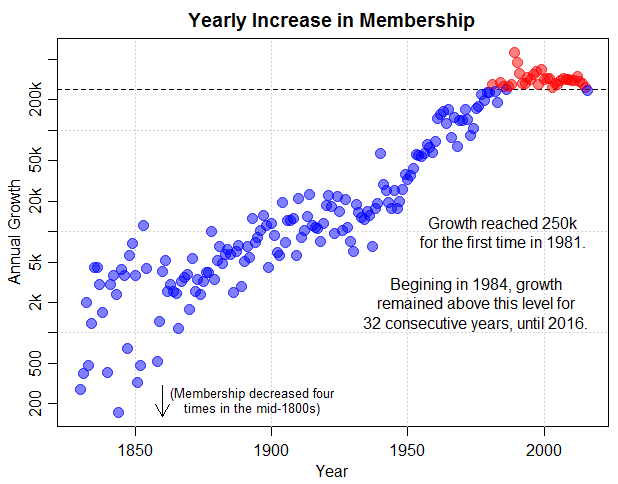
In the Saturday Afternoon Session of General Conference on Apr 1, 2017, the church announced a membership of 15,882,417. Combined with last year’s total, this represented an increase of 248,218 members and 1.59%. For many denominations, this would be a banner year. However, for the LDS church it represents a remarkable underperformance relative to historical trends and enthusiastic predictions by some members.
Absolute growth
In terms of absolute growth, the addition of nearly a quarter million members is still a substantial achievement. After all, the church didn’t reach 250,000 members total until 1897. However, since 1984 the church had reported growth of at least that magnitude for 32 consecutive years until last Saturday. Reported is an important word here, as membership totals reported in General Conference were rounded off to the nearest 10,000 from 1984-1991, and there are several statistical anomalies in the various time series suggesting that totals sometimes reflect incomplete reports (usually reflected by an anomaly in the opposite direction in the next year).
The Sins of Pride and Self-Negation (or, How I Learned to Lighten Up a Little About Service)
In 1960, a thinker by the name of Valerie Saiving wrote an influential article which is often considered the beginning of modern feminist theology, critiquing traditional models of sin which were centered around pride. Since such perspectives considered pride or excessive self-assertion to be the most basic sin, they understood the process of overcoming sin as necessarily involving a move toward greater selflessness. Love was defined in such approaches as being “completely self-giving, taking no thought for its own interests but seeking only the good of the other.” ((Valerie Saiving, “The Human Situation: A Feminine View,” in Womanspirit Rising (San Francisco: Harper & Row, 1979), 26.)) Saiving raised the objection that these models ignored some basic differences in the self-development of women and men, and arose from an essentially masculine perspective. The crucial point that these formulations overlooked, she argued, is that there is danger in the other direction as well, as it turns out that too much selflessness, far from producing someone in an idealized and virtuous state, leads to the development of a kind of “chameleon-like creature who responds to others but has no personal identity of his [or her] own.” ((Ibid., 41.)) Saiving saw this as a temptation to which women are particularly vulnerable. Read More
A Person Who Stays
Like most kids born into the church, I was baptized at the age of eight. I turned 42 earlier this year. (Tangential sign that you are getting at least middle-aged: I actually had to stop and check the year and subtract to verify my current age. But yes, it’s 42.) That means I have a solid 34 years of membership in the LDS church. I was by no means consistently active for all those years. My first foray out of Mormonism happened about thirty seconds after I finished my last class at BYU, and was no longer required to have an ecclesiastical endorsement. That time around, I left for a good year and a half. But looking back, “left” is a very strong word for what I did. I mean, I quit going to church every week (though I’d still drop by for special occasions). But I still did stuff like praying and reading my scriptures, and even (such are the contradictions of life) attending an Institute class for a while. And given that I was living in Provo, with five Mormon roommates, I was still pretty immersed in the whole thing. In a stroke of good fortune, I got to take a night class on Mormon literature from Eugene England, who had found refuge at UVU at that point, and I loved it. It was an environment where there was room for real questions; I found there a constructive and supportive space to begin the process of seriously wrestling with my Mormon heritage and what it meant to me. Given my continuing attachment to the LDS tradition, I don’t think anyone was terribly surprised when I eventually decided to come back to church. Read More
Worthiness
My favorite Richard Dutcher movie, one perhaps lesser known than God’s Army or States of Grace, is a thought-provoking film titled Brigham City. It’s a highly suspenseful murder mystery set in a small Mormon community, and it deals head-on with some hard religious questions. The final scene is deeply moving. I won’t spoil it by giving too many details, but I will say that a crucial element of that scene is the question of what it means to be worthy to take the sacrament.
About eight years ago, when I was still a PhD student, I got to design and teach a Master’s-level class on Mormonism at my school. One week, I showed them Brigham City. The group of mostly Protestant students quite liked the movie, but they said something that has really stayed with me. They said that their take on that scene was different than mine had been, because they came from traditions in which there isn’t a worthiness requirement to take communion (or the sacrament, in Mormon lingo); in fact, one of them said that when you feel unworthy, that’s actually the time when you need it the most. I’ve thought a lot about that over the years. Read More
Cleverness and Kindness
The Jewish philosopher Abraham Joshua Heschel is often quoted as having said, “When I was young, I admired clever people. Now that I am old, I admire kind people.” I’m not that old yet, I wouldn’t say, but I’m also realizing these days that I’m not exactly young, either. And I find that I’m with Heschel in experiencing this shift in perspective as my age has increased. Read More
Thoughts on My Current Religious Meanderings
I posted this on Facebook the other day, with reference to my recent exploration of the Episcopal tradition, and I thought I’d share it here as well.
I’ve been wanting to express appreciation to my believing Mormon friends in particular who’ve been so supportive of my recent forays into other religious possibilities. It means a lot to me that no one has lectured, or asked me if I just have Word of Wisdom issues, or played the “you’re falling into apostasy” card, and that so many of you even seem excited and happy for me. Because I am in fact excited and happy. This has all been spiritually nourishing and powerful, and because I am still in many ways very Mormon, I have to think that it unquestionably passes the Moroni 7:41 test (“every thing which inviteth to do good, and to persuade to believe in Christ, is sent forth by the power and gift of Christ; wherefore ye may know with a perfect knowledge it is of God.”) Read More
Conference Talks Most Likely to Be Edited
Ever since Boyd K. Packer’s October 2010 Conference talk “Cleansing the Inner Vessel” was significantly edited between the version he delivered and the printed version, I’ve seen increased attention paid to differences between the spoken and printed versions of Conference talks.
Given that we’re in the relatively brief window of time between all the Conference talks being given and the release of their printed versions (other than the Women’s Session, for which they’re already out), I thought it might be fun to speculate about what edits we might see this time around. Here are some of my guesses. I’d love to hear yours in the comments.
| Speaker | Spoken version | Printed version (my guess) |
|---|---|---|
| Brough, Saturday morning | “I earnestly prayed to know if I had to give my dog away [after my father was called as a mission president]. My answer did not come in a moment. Rather, a specific thought kept penetrating my mind: Don’t be a burden to your parents.” | “I earnestly prayed to know if I had to give my dog away [after my father was called as a mission president]. My answer came in a flash, as my beloved dog was simultaneously struck by lightning and run over by a train. I rejoiced in the miracle God had provided to keep me from being a burden to my parents.” |
Some (Okay, Actually Way Too Many) Notes Made in the Absence of Depression, about Augustine, Willpower, and How CBT Failed Me
I recently emerged from a very long depression. While I am quite enjoying this rare life interlude of an existence not characterized by overwhelming apathy and despair, and am wanting to just savor the radical sense of being remarkably and unexpectedly enthusiastic about this whole being alive thing, my therapist keeps pushing me to think about how I can cope better when the depression returns. This isn’t a fun question to tackle, of course, because in my current state I’d prefer to believe that the depression won’t ever return. I do realize that this is completely wrongheaded. My particular manifestation of bipolar disorder is constituted by something like eighty percent down, fifteen percent in between, and a mere five percent up. (To really look at that, which I don’t often do, makes me feel both profound grief about how much of my life I’ve lost to depression, and intense rage about the unfairness of it all. Which is probably why I don’t like to think about it too hard.) But I do know in my head, at least, that the chances of the depression being permanently gone are close to zero, and I’ve thus been reluctantly willing to do the kind of strategic thinking that my therapist is asking me to do.
Trump to Resign Presidency to Become Mormon General Authority
In an unprecedented move, US President Donald J. Trump announced today that he will be resigning the Presidency, convert to Mormonism, and become a member of the First Quorum of Seventy, one of the three highest governing bodies in the Salt Lake City-based church. Trump made the announcement in a press conference held on Saturday morning in Salt Lake City, just prior to the second session of the church’s 187th annual conference. In the press conference, Trump was joined by Dallin H. Oaks, a member of the Quorum of the Twelve, the LDS church’s second-highest governing body.

Exploring the Episcopal Church
Several months ago I decided, for the umpteenth time in my life, that I needed a break from church. All the usual factors were at play, from frustration with the expectations surrounding gender and marriage to frustration with the culture of obedience and family-worship. The immediate catalyst for my leaving was not unrelated to these things. My older sister moved into the ward, and we started going to church together. This should have been fun, and of course I was happy she was there. But watching the sharp differences in the ways we were treated by other members of the ward just brought home to me that no, I was not imagining my marginalization in the community. People who barely registered my existence went out of their way to talk to and include her. People would literally talk over me, if I was sitting next to her, to engage her in conversation, without appearing to notice I was even there. I may as well have been a piece of furniture. She was asked to speak in sacrament meeting soon after moving in, and had a calling shortly thereafter—very different from my experience moving into the ward nearly a year earlier. Read More
I’m bored of white men
White men are 31% of the US population, but hold 65% of elected offices in the United States.
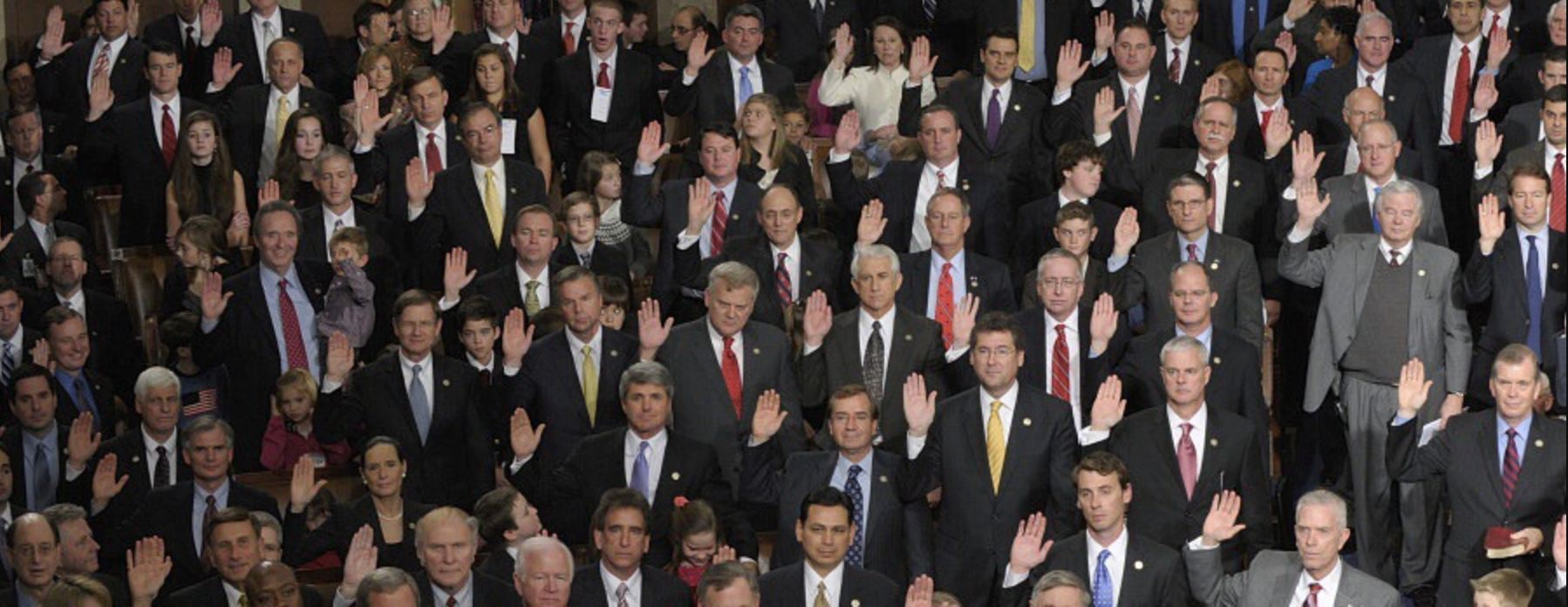
That 31% of the population is also:
- 60% of the authors reviewed in The New York Times
- 82% of film directors and most of the speaking characters
- >90% of Fortune 500 CEOs
- most film executives, movie producers, and sports team owners
- 98% of presidents
- and, of course, 100% of LDS prophets and apostles.
With power in our society so thoroughly dominated by white people, and men in particular, the stories and perspectives we’re exposed to run the gamut, to paraphrase Dorothy Parker, from A to B. I like white men–I’m related to them, friends with them, work with them–and their personalities are interesting and their opinions worth considering, to be sure, but still: seeing and hearing from white men so much, in so many places of power and influence, is like eating the same thing every day. Variety is the spice of life, and I’m hungry for more and different foods in my diet.
As an example of a similar effect, since I’m a book lover, think of novels about the Holocaust. I’ll start: The Book Thief, All the Light We Cannot See, Number the Stars, The Reader, Suite Française, Schindler’s List, Code Name Verity, The Last of the Just, The Boy in the Striped Pajamas, Everything Is Illuminated and I’m just naming the ones I’ve read, and not even including memoirs, non-fiction treatments, or movies. Many of these are great novels, and stories about the Holocaust are important. And yet, can you name nearly as many novels about the Khmer Rouge? I’ve got In the Shadow of the Banyan, and then it turns out the other I was thinking of was about Vietnam instead. And how many novels can you name about the 1990s genocide in Rwanda? I’ve gone out of my way to read about Rwanda after visiting there a few years ago, and I can still only name a few memoirs and non-fiction books. And where are the novels about the genocides in Bosnia, Armenia, Namibia, and many other places? Imagine how much more vibrant our literary landscape would be with a broadened range of cultures, histories, and individual stories to draw from, beyond those belonging to primarily white people in the West.
And on a Mormon note, imagine a General Conference with a leadership roster that reflected a truly international and truly diverse Church, instead of one dominated by white men. We’d be able to hear people speak about their personal experiences of growing up on farms in Utah and flying airplanes in Germany, but also of fleeing Spain during the Civil War, integrating the hospitality industry in the early 1970s, learning about the Church from Reader’s Digest, giving up a child for adoption by a friend, or sneaking through security checkpoints to get to church. I love that I can find those stories online (major shout-out to the Mormon Women Project!) but I want more of them everywhere–in my ward, in the Ensign, over the pulpit in General Conference.
We should end this overindexation of white men and their perspectives for all kinds of reasons–a world with more equal representation would better live up to the exhortation to recognize neither Jew nor Greek, bond nor free, male nor female–but, on top of all the reasons of justice and equality and striving for Zion, let add my complaint: this is boring.
Happy Valentine’s Day from the Trump Administration


Sing a song of crafting
For far too much of my life, I avoided activities I saw as overly feminine. I was no tomboy—that requires a base of athleticism I didn’t have—but, as an intellectually-inclined child, I let my bedroom get messy, never moved beyond boiling water in my kitchen skills, eschewed crafting, and never bothered with beauty routines.
Who will GAs endorse if the Johnson Amendment is repealed?
Donald Trump has promised to get rid of the Johnson Amendment. This law prohibits church leaders from endorsing or opposing political candidates from the pulpit if the churches want to maintain their tax-exempt status. (It also applies to non-religious non-profits, but it’s the application to churches I’m interested in.)
I have no idea how difficult it might be for Trump to actually get this done. What I’m curious about is what General Authorities would do if he did. They clearly pay close attention to American politics, so I’m sure they would immediately see the implications for them and for local leaders in American wards and branches. How would they respond? I can imagine a few scenarios: