Fastest hymn: Christ the Lord is Risen Today, Sunday morning
Slowest hymn: Consider the Lilies, Sunday morning
Best hymn: Christ the Lord is Risen Today, Sunday morning and Redeemer of Israel, Sunday afternoon
Worst hymn: Lord, I Would Follow Thee, Sunday afternoon, was too soft and slow. Also, I dislike We Thank Thee, O God, for a Prophet in principle, regardless of how it’s sung or played.
Longest talk: 1683 words, D. Todd Christofferson
Shortest talk: (excluding Dallin H. Oaks’s brief opening and closing talks) 881 words, Pedro X. Larreal
Overall, talk length was down markedly. The average was about 1200 words, or 1260 words excluding Dallin H. Oaks’s brief opening and closing messages. In October 2025, the average was about 1620 words, and the shortest was 1242 words, which would have been right in the middle this time.
Longest prayer: 110 seconds, Amy A. Wright, Sunday morning benediction
Shortest prayer: 59 seconds, Andrea Muñoz Spannaus, Saturday afternoon benediction and Paul V. Johnson, Sunday morning invocation
Overall, prayers were less variable in length than last Conference, when there were three over 130 seconds, but also three of 50 seconds or shorter. The average length was down a little, from 90 seconds to 85.
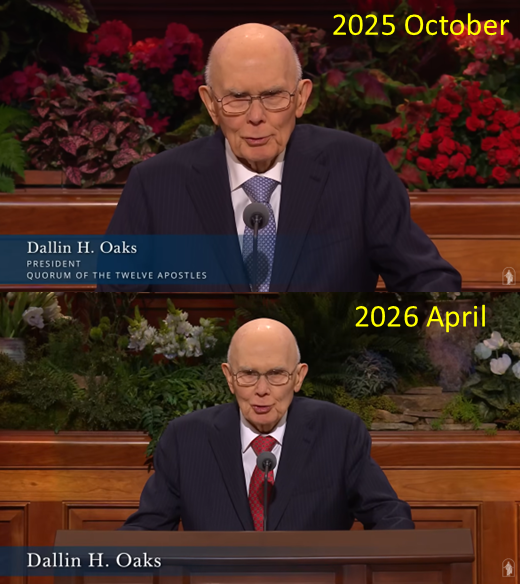
Ways Conference was different from Nelson-era Conferences:
- The elimination of the Saturday night session, teased in 2021, was finally carried out.
- Talks were shorter, as mentioned above. This seemed clearly designed to fit more speakers in each session.
- I feel like there were fewer personal stories told than in past Conferences, perhaps as a result of talks being shortened. To me, this is a sad change, as personal stories are often my favorite parts of talks.
- Dallin H. Oaks spoke more than once (although only one was a full-length talk), something Russell M. Nelson had stopped doing in the past few years.
- Russell M. Nelson was referred to 157 times in October 2025 (74 times in talks and 83 times in footnotes). This Conference, he was referred to 38 times (9 in talks, 29 in footnotes). And I’m happy to see that speakers haven’t just re-aimed their obsequiousness at Dallin H. Oaks, who got 90 references (less than 60% as many, 39 in talks, 51 in footnotes). Let’s hope this pattern continues of not having every speaker refer to the Church president multiple times per talk.
- Speakers were identified on the screen with only their names, rather than their names and titles as before. I like this change. It feels like a tiny step away from the worship of hierarchy.
Random observations:
- D. Todd Christofferson on Saturday morning and Henry B. Eyring Sunday morning mentioned Tabernacle Choir members joining from “outside the United States,” and then listed places they came from. One of the places listed was Puerto Rico, which is part of the United States, even if it’s not a state. I hope this is an innocent error, but in this era of Trump not wanting to do anything for Puerto Rico because he wants to define them out of the country, it seems important.
- When there is a solemn assembly to sustain Church leaders in one session, and then the usual sustaining vote in the next, it brings to mind George R. R. Martin’s line “Any man who must say ‘I am the king’ is no true king.”
- I think it’s unfortunate that Conference couldn’t be moved to not collide with Easter. That we couldn’t take even this small, administrative step really shows how unserious we are as a church about joining mainstream Christians in celebrating it. And not only does Conference ruin Easter. Easter ruins Conference. As is typical when the two coincide, some speakers (this time Dieter F. Uchtdorf and Ronald A. Rasband) feel the need to recount the story of Easter. I know the story. I’d rather hear something different. If we’re going to have an Easter liturgy, let’s have it, but if we’re going to have Conference, let’s have that instead.
Best title: “Love All; Love Each,” Gérald Caussé
Worst title: “Follow the Prophet; He Knows the Way,” Michael John U. Teh. I know this is conventional Mormon doctrine. I find it off-putting as it seems so clearly false.
Best visual aid:
- Clark G. Gilbert used Minerva Teichert’s painting of a pioneer woman waving to people to follow her.
- Eduardo F. Ortega shared photos of his mother joining the Church in Argentina in the 1950s.
Most surprising visual aid:
- Clark G. Gilbert shared a photo of a family who he encouraged to be sealed in the temple, and right there, on the temple grounds, the husband in the family not only has a beard, he has long hair! I’m kind of surprised Gilbert would not only countenance such things, but that he’d advertise them to the whole Church like this!
Copy editor needed:
- Clark G. Gilbert told a story of how he helped persuade a former BYU football player to get baptized. When first approaching him, Gilbert said he “appeared weary of entering a spiritual discussion.” I think the word he’s looking for here is wary.
- Wan-Liang Wu told the story of the missionary Aaron converting Lamoni’s father. He introduced the story by mentioning a missionary and an old king, and then launched into it, referring to Aaron by name without pointing out that he was the missionary.
Fact checker needed: Ronald A. Rasband began his talk, “This Easter Sunday, all Christians, brothers and sisters in the Lord, honor and celebrate the Resurrection of our Redeemer, Jesus Christ.” But of course Western and Orthodox churches use different rules for deciding when Easter is, and this year, while Western Christians celebrated on April 5th, Orthodox Christians will celebrate on April 12th.
That isn’t how brackets work: Neil L. Andersen rewrote a few verses in Isaiah 40 with creative use of brackets. In particular, he made verse 31 sound like it’s about married couples. Here’s what he quoted from the verse. All brackets and ellipses are his.
“[And together, as you] wait upon the Lord … [you] shall mount up with wings as eagles; [together, you] shall run, and not be weary; and … walk, and not faint.”
And here’s the original verse:
But they that wait upon the LORD shall renew their strength; they shall mount up with wings as eagles; they shall run, and not be weary; and they shall walk, and not faint.
Mixed messages:
- Multiple speakers–Michael John U. Teh, Wan-Liang Wu, and Clark G. Gilbert–talked about “gospel culture” or the need to give up bad traditions. The frustrating thing about this type of discussion is that in the absence of specifics, and of course they weren’t specific, it just fuels Boyd K. Packer’s infamous unwritten order of things. Gospel culture is whatever your bishop thinks it is. Better wear a white shirt and vote against the socialists. On the other hand, Gérald Caussé mentioned that congregations are “enriched by diverse backgrounds, cultures, and experiences,” although surely some of those cultures are ones that men like Gilbert yearn to stamp out.
- Brian J. Holmes, Michael John U. Teh, and Ulisses Soares hammered on the usual “follow the prophet” message. Interestingly, Edward B. Rowe told a very similar story to the one that Holmes told (a man led through mine fields by a knowledgeable guide, a blind marathon runner tethered to a guide), but he really focused on Jesus as the guide rather than GAs as Holmes and the others did.
Best stories:
- Thierry K. Mutombo told of how he and his wife had four of their ten children die. Their extended family told them tradition required that they separate. I like how humbly but firmly he told them that no, that wouldn’t be happening.
- Dallin H. Oaks told of a woman who worked as a nurse, and one of her patients was consistently awful to her. One evening he fell out of bed and died shortly thereafter. But before he did, she had a moment of realization where she felt she knew God’s love for him.
Worst stories:
- Clark G. Gilbert told about how he helped prod a non-Mormon former BYU football player to get baptized by telling him that his deceased parents wouldn’t mind, as they were now Mormon.
- Jorge T. Becerra told a story about how a Seventy guilted him into selling the car he needed for his business to pay his back tithing. Being unaware of, or wanting to obscure, how guilting works, he emphasized that the Seventy didn’t actually suggest it, he just kinda sorta suggested it. Then, by a “miracle,” he was able to take over payments of his friend’s car. I strongly dislike stories like this being told, because the more likely stories where the person sells the car and loses his business and his house and family and dies never get told.
- Clement M. Matswagothata told a story of how, as a discouraged young stake president, he was comforted by a child in a ward he was visiting whose family had been praying for him. The story wasn’t bad, but his conclusion from it was precisely backward: “Just as that family prayed for me, there is someone praying for you.” Of course this is false. It is precisely because he was a stake president that people were praying for him.
- Neil L. Andersen told two little stories on the theme of how his wife is a better person than he is. In the first, at the beginning of their marriage, he (but not she) made liberal use of little napkins with a Shakespeare quote about love not changing when it finds alteration. In the second, Boyd K. Packer said that his and his wife’s 25th anniversary was an accomplishment for his wife, but not for him. Although they weren’t deployed this way in this talk, this type of story is infuriating because it’s so often used to prop up the “women are so holy that they don’t need the priesthood, and men are so bumbling that they’d be nothing unless they had exclusive access to it” apologetic.
- Henry B. Eyring told of how he felt peace and almost joy at his wife’s funeral. Along similar lines, D. Todd Christofferson told a story told to him by David A. Bednar about a woman who was calling him about two young women who had been hurt in a car accident, when she learned that her own daughter had died in the same accident. She was unfazed, and Bednar praised her for not “turning inward.” I hate stories like this being told in Conference, because they normalize the idea that anyone who experiences normal grieving when a loved one dies is faithless.
- Along similar lines, Michael John U. Teh told a story of visiting a man who was suffering from cancer for which treatment was failing. He was surprised to find how the man was happy and “never asked why.”
- Taniela B. Wakolo told multiple stories of people successfully being pressured into getting baptized, sometimes after years. One of these stories was his own. That’s great for him, but every time stories like this are shared in Conference, thousands of Church members take fresh hope and redouble their own pressuring efforts on their non- and post-Mormon family members and friends.
Funniest stories:
-
- David J. Wunderli told of a time when he was hiking with his family, and his six-year-old son found his backpack full of interesting rocks he’d found too heavy to carry. Wunderli jokingly suggested that his son take out his picture of Jesus to lighten his load. His son concluded “Dad, you’re not as smart as I thought you were.”
- Clement M. Matswagothata told of how he was nervous before giving a talk in stake conference, and his daughter reassured him, “Dad, don’t worry about making a mistake. No one here will remember our long surname anyway.”
Best lines:
- Kristin M. Yee: “We may not be able to fix difficult or heartbreaking circumstances as we hope; some changes are not ours to make.” I found the second line in particular so striking. I like the acceptance of others’ agency and of the reality of the limits of our power in the world.
- Gary E. Stevenson, comparing found luggage to saved people: “This is more than logistics. This is redemption.”
- Gérald Caussé: “To [the Lord], all people upon this earth are our neighbors—there are no strangers or outcasts, only brothers and sisters.”
- Clement M. Matswagothata: “In the Old Testament, the Lord taught Moses this assuring truth: ‘I know thee by name.’ In Eden’s garden, He called Adam. At the empty tomb, He called Mary. On the road to Damascus, He called Saul. And in the Sacred Grove, He called Joseph. All by name.”
- Emily Belle Freeman: “Peter was to be more than just a fisherman; he would now become a shepherd.”
- Dale G. Renlund: “‘All mankind may be saved’ because of Him and His atoning sacrifice. All means everyone. If everyone, then anyone. If anyone, then even one. And if even one, then even you.” Italics are Renlund’s.
- Susan H. Porter: “I am grateful today to speak to Heavenly Father’s young children. Heavenly Father’s older children may also choose to listen.”
Worst lines, toxic positivity category:
- Clement M. Matswagothata, in a list of possible burdens, included “prayers that seem unanswered.” Can we not even acknowledge that sometimes prayers don’t just seem unanswered, but actually are unanswered?
- Dallin H. Oaks referred to “deaths we might call premature.” It’s okay to admit that some deaths are premature. Just put away your “everything happens for a reason” and “God is in control” bromides and let people grieve.
Worst line, idolatry category: Neil L. Andersen: “We believe in eternal marriage, we teach of eternal marriage, and we seek an eternal marriage.” This sounds like a bad mashup of 2 Nephi 25:26, pointedly substituting marriage for Jesus, and the 13th Article of Faith.
Worst line, is this a euphemism category: Dallin H. Oaks: “Young men and women are peacemakers when they forgo the temporary pleasure of self-gratifying activities and involve themselves in service projects and other acts of kindness.” What exactly does he mean by “self-gratifying activities” here? I suspect from context that he’s thinking broadly, but given GAs’ preference for being super euphemistic about sexual things, I feel like there’s some basis for thinking he means masturbation.
Worst lines, that’s a nice theory but we live in the real world category:
- Patrick Kearon: “Common consent is not a mere formality but a beautiful mix of our agency, unity, and faith.”
- Patrick Kearon: “. . . becoming the President of the Church. This is a call he [Dallin H. Oaks] didn’t seek or aspire to.”
- Taniela B. Wakolo: “The temple stands as a symbol of hope, not pressure.”
Worst line, unexamined privilege category: Quentin L. Cook: “Can you imagine how it felt for two former missionary companions, then serving as Apostles, and our sweet wives, having the opportunity to walk where Jesus walked, to read from sacred scriptures of the last days of His mortal ministry, and to feel the spirit of these miraculous events?” Well rub it in, why don’t you? I not only don’t get to hang out with my powerful friends who then orchestrate for me to join them in the powerful clubs they’re in, I don’t have the money to travel halfway around the world to see historic places.
Worst line, Mormon exceptionalism category: Clark G. Gilbert: “Helping others requires you to stay in your covenants.” So no member of another faith (or no faith) can help anyone? I mean maybe he’s talking about the context of spirituality, but still, this seems overly exclusive.
Worst line, people as products category: Gary E. Stevenson: “There is no greater need and no greater return on this investment than when it is made with Primary children, young men, young women, and young adults.” I like the idea of helping out young people. But I don’t like Stevenson’s framing of it in business terms rather than relationship development terms.
Worst line, missing asterisk category: D. Todd Christofferson (in his note 19): “Jesus is not jealous of His powers but enables others to exercise those same gifts and powers and feel the joy of service.” *If they’re boys or men.
Lines from speakers gunning to take Neal A. Maxwell’s position as the alliterative apostle:
- Gérald Caussé: Referred to “the God who governs galaxies.” For bonus points, Caussé was talking about a Neal A. Maxwell talk at the time, but the alliteration is Caussé’s not Maxwell’s, so he out-Maxwelled Maxwell!
- Dieter F. Uchtdorf, speaking of the women who found the empty tomb: “I have tried to imagine their heartache, helplessness, and hopelessness.”
- Alan R. Walker quoted D. Todd Christofferson about converting “tribulation to triumph.”
Best line to get on Boyd K. Packer’s bad side: Patrick Kearon: “I also acknowledge that there are those who, owing to exceptional circumstances, are unable to respond to a calling at a given time.”
Best line to get on Wilford Woodruff’s bad side: Patrick Kearon said that in becoming Church president, Dallin H. Oaks was “claiming no infallibility.”
Best line to get on Ronald A. Rasband’s good side: Kristin M. Yee: “I find the Savior when I minister. This is by divine design.”
Best word to get on James E. Faust’s good side: David A. Bednar and Gérald Caussé, and Brian J. Holmes quoting David A. Bednar all used the word supernal.
Best lines to get on Russell M. Nelson’s good side:
- Kristin M. Yee: “Choosing to minister . . . requires sacrifice, faith, vulnerability, and trusting things will work out as we let God prevail.”
- David A. Bednar: “I pray for the assistance of the Holy Ghost as we consider a higher and holier understanding of what it means to endure to the end . . . “
Best lines to get on Trumpists’ bad side:
- Gary E. Stevenson: “In the end, we are all one family.”
- Pedro X. Larreal mentioned the dreaded word pronoun (although of course not in the context of cisgender and transgender people).
- Dallin H. Oaks: “In a democratic government we should seek fairness for all.”
Funniest line: Wan-Liang Wu told of how as a child, he went with his mother to different Chinese temples to take special cakes as offerings for different Gods. He concluded, “I loved going with my mother because when the rituals were over, I got to eat all those delicious cakes.”
Best quotes:
- Kristin M. Yee quoted Jeffrey R. Holland as saying we can help “the God and Father of us all a helping hand with His staggering task of answering prayers, … drying tears, and strengthening feeble knees.” Ellipses are Yee’s.
- David A. Bednar quoted Moroni 7:48 (ellipses his): “Wherefore, … pray unto the Father with all the energy of heart, that ye may be filled with this love, … that when he shall appear we shall be like him, for we shall see him as he is.”
- David J. Wunderli, in his note 16 quoted Patrick Kearon as saying that God “hasn’t set a limit on your second chances.”
- Gérald Caussé quoted Joseph Smith: “a man filled with the love of God, is not content with blessing his family alone, but ranges through the whole world, anxious to bless the whole human race.”
- Dallin H. Oaks said “The Prophet Joseph Smith taught that we should ‘pour forth love’ to all people.”
Worst quotes:
- Patrick Kearon quoted Gordon B. Hinckley about a solemn assembly: “Every individual [has stood] equal with every other in exercising with soberness and in solemnity his or her right to sustain or not to sustain [him] who, under the procedures that arise out of [revelation], [has] been chosen to lead.” Brackets are Kearon’s. The “equal” part is obviously untrue. The sustaining goes from most important to least important group.
- Jorge T. Becerra quoted Gordon B. Hinckley: “I know that the people are in difficult circumstances. I know that many of them are unemployed. I know that many of them work for very meager wages. I know that they live in simple and inadequate little houses, the only thing they can afford. I believe they will not walk out of poverty unless they pay their tithing.”
- Chi Hong (Sam) Wong quoted Alma 37:13: “O remember, remember, my son Helaman, how strict are the commandments of God. And he said: If ye will keep my commandments ye shall prosper in the land—but if ye keep not his commandments ye shall be cut off from his presence.” I know this is very conventional Mormon thought. It’s also straight up prosperity gospel and I don’t like it.
Weirdest repeat quote: Eduardo F. Ortega quoted 2 Nephi 31:20 (the verse about pressing forward with a steadfastness in Christ) three separate times, each time cutting off at a different point. The first time, he ended at “steadfastness,” the second time at “Christ,” and the third time he quoted the entire verse. And this wasn’t part of making some building point. It felt kind of random.
Weirdest quote formatting: Alan R. Walker quoted D. Todd Christofferson and he italicized the entire quote. It doesn’t seem like a formatting error either, as he added “emphasis added” at the end of the corresponding footnote (note 9). This just seems like an odd choice to me. It seems like the point of italics is to emphasize some words over others, so if you use them on all the words, they’re meaningless.
Most obsequious quote: Pedro X. Larreal’s first quote in his talk was a quote of Dallin H. Oaks, who was in turn quoting Russell M. Nelson. Just to cover all his submission to authority bases, presumably.
What wasn’t said:
- David J. Wunderli referred to something Dallin H. Oaks said “in his first interview” after becoming Church president. Along similar lines, Gérald Caussé reported something he had said to “a journalist.” In both of these cases, these weren’t typical interviews with ordinary journalists. They were puff piece interviews with Church employees.
- Clark G. Gilbert, in telling a story of a couple who was persuaded to come back to church in spite of the wife’s issues with the Church, carefully avoided saying what any of those issues were.
- Michael John U. Teh said that his parents originally followed “the predominant faith of my native country.” But he doesn’t name the faith. He’s from the Philippines. A quick search shows it’s Catholicism, not a fringe or niche religion most people haven’t heard of. Why not name it?
- Ulisses Soares talked about Jesus as the true vine and contrasted him with “other vines that present themselves as legitimate,” but in such vague terms that it wasn’t at all clear to me what he was thinking of other than baddies in general.
- Edward B. Rowe told of a time when he went to a former war zone and had to carefully follow a guide to avoid land mines. He said that there had been a border dispute between countries, but he carefully didn’t name them. I get the idea of trying to avoid getting caught up in the particulars of a story, but I think the vagueness also makes it less interesting.
- Quentin L. Cook told of taking Jewish leaders on tours through temple open houses. He didn’t mention whether or not these were among the times when they had to remind the Church that we needed to stop baptizing Holocaust victims.
Most footnotes: 51, Aaron T. Hall
Fewest footnotes: 0, Jorge T. Becerra. He used in-text references. (Dallin H. Oaks also had zero footnotes in his first appearance at the pulpit, but he was just briefly introducing the solemn assembly.)
Most words in footnotes: Kristin M. Yee had 1690 word in her footnotes, making them quite a bit longer than her talk, which had 1353 words.
Longest single footnote: Kristin M. Yee also had the longest single footnote. Her note 29 was 322 words.
Most interesting footnotes:
- Clark G. Gilbert in his note 11 cited a Substack called Graphs about Religion where a religion researcher named Ryan Burge posts fun, quick analyses of data about religion in the US. (Funnily to me, Gilbert got the URL wrong in his footnote–it’s www.graphsaboutreligion.com, and graphsaboutreligion.com doesn’t work–and Burge in turn links to a Deseret News article about himself, but he gets the name wrong, calling it the Deseret.)
- Gary E. Stevenson in his note 1 referred to the website about baggage handling from a company that handles air travel IT.
- Dieter F. Uchtdorf’s note 13 discussed the women at Jesus’s tomb and concluded in part “Perhaps a lesson we can learn from this is that these women represent all of us. No one is considered above or superior to another.”
Most unusual footnote source: Quentin L. Cook cited the Quran in his note 13.
Weirdest footnote: Ronald A. Rasband, in his note 20, says that “The Holy Land . . . is not mentioned explicitly in the Bible.” The only way I can make sense of this is to assume he was saying that the phrase doesn’t appear in the Bible.
Best names for Jesus:
- Clark G. Gilbert: “Repairer”
- Eduardo F. Ortega: “Author and Finisher of Our Faith”
- David J. Wunderli: “Our Relief”
- Dieter F. Uchtdorf: “our guide for making choices”
- Edward B. Rowe: “Master Healer”
- Aaron T. Hall: “Healer,” “Advocate,” “Lawgiver,” “Deliverer,” among others.
Thanks for gender-neutralizing: D. Todd Christofferson referred to Moses 1:39, but instead of quoting and saying “the immortality and eternal life of man,” he said “the immortality and eternal life of God’s children.”
Thanks for using more inclusive language: In her note 7, Kristin M. Yee quoted a passage from James E. Talmage’s The House of the Lord about obligations taken on in the endowment. She quoted it as “to devote both talent and material means to the spread of truth and the uplifting of [humankind],” where the original had “uplifting of the race.” Referring to “the race” might refer to humanity, but it also might refer only to European-descended people, especially given that the priesthood/temple ban was in place when Talmage wrote the book, so I appreciate that Yee modified the wording to make it more inclusive.
Thanks for saying “believe”: Kristin M. Yee: “I believe our Father in Heaven wants you to be happy.”
Champions of non-KJV Bibles:
- Dieter F. Uchtdorf quoted the New KJV multiple times and also referred to the NIV (note 13) and the ESV (note 5).
- Dale G. Renlund referenced the New International Reader’s Version (note 8).
Champion of new hymns: Dale G. Renlund quoted one new hymn and referred to four others in his footnotes. Clearly a fan of hymns, he also referred to five hymns from the existing hymnal.
Best talks:
- Gérald Caussé gave a lovely talk on the love of God for us individually.
- Kristin M. Yee’s talk on ministering felt kind and hopeful.
Worst talks:
- Clark G. Gilbert’s call for people on the fringes or outside of the Church to “Come Home” is hard to take seriously when as Commissioner of Church Education he spent so much energy drawing bright boundary lines to chase people out.
- Jorge T. Becerra’s talk on tithing was an abomination. The very least the Church could do now that it’s public knowledge that it’s sitting on an unfathomably large investment portfolio is to shut up about tithing for a few decades or centuries or possibly forever.
- Brian J. Holmes titled his talk “Jesus Christ Is the Way,” but spent the latter half hammering on the point that with Jesus unavailable in person, everyone had darn well better be following the prophet to the letter!
- Neil L. Andersen worships the idol of celestial marriage. I’m not surprised, but I don’t want to hear about it.
Talks I’m mixed on:
- Patrick Kearon had some useful things to say about callings, like acknowledging that we can’t always do what we’re called to do, and that the Church president isn’t infallible. But I was also frustrated that he repeated these fantastical ideas like that common consent means anything. That’s a nice aspiration, but it isn’t reality.
- David A. Bednar attempted to redefine “enduring to the end” to make it sound less miserable. I appreciate his thought, because the phrase has always sounded to me like we need to put our heads down and tough life out, because it’s going to be a miserable slog. I hope his alternative reading of enduring as becoming possessed of charity is widely accepted. But I still feel like he’s clearly just making stuff up.
My heretical reviews of past General Conferences:
October 2025
April 2025
October 2024
April 2024
October 2023
April 2023
October 2022
April 2022
October 2021
April 2021
October 2020
April 2020
October 2019
These are wonderful and I look forward to these heretic reviews more than general conference itself!
Thank you so much for writing them!
Thanks so much, FooBar! I really appreciate hearing that you enjoy them so much!
This is always much appreciated and enjoyed – I am truly impressed by the level of attention-paying and slogging-thru-footnotes that this opus represents. Thank you.
Thanks for reading and commenting, Raymond! I’m glad you enjoy it!
Perhaps you already have the data at your fingertips and can answer this with less work than it would take me:
With the elimination of the Saturday evening session, what was the impact on total number of speakers, and total time speaking?
In the past (I don’t remember when) I noticed that apostles got 15 minutes and other speakers got 12. (I think this might have been from a year where there was one session that was packed with speakers and everyone in that session got 9.) Just glancing at video lengths on YouTube, it looks like apostles were 11-13 minutes and everyone else was 8-10. This is probably to get more people a chance to speak. Certainly the time spent for the solemn assembly stuff created further time crunch. Any indication that music was given less time in the shortened format?
Thank you, I always enjoy this.
Bednar seems to think everything he says in his talks, which usually tend to redefine something, is higher and holier than whatever anyone else has said on the subject. His rhetoric about moral agency instead of free agency has infected the minds of some of the older folks in my ward and hearing their constant comments in classes has become painful.
I note that the three most recent men to be the youngest General Authority are all black Africans (Mutombo,Morrison,and Matswagothata,two of whom being noted here as having spoken being what brought this to mind…not a committee Brigham Young would want resurrecting him!)…before them was Elder Tai,who I noted in a comment on the previous post succeeded Elder Dube(another black African) as the youngest among the Presidency of the Seventy…I am not sure if the newly sustained Elder Fale (of a Pacific Island descent but Provo-born) is even younger or slightly older than Matswagothata as his official bio is not out yet.
I found the lack of titles under the speakers’ names off-putting…to me it carries an undertone of “you’re supposed to KNOW who this person is…were you paying attention before?”.
Truly brilliant. I laughed so many times. Felt pangs of hope, humanity, complexity. Your dedication to doing this thorough and tiring work is really appreciated. There are good people at the helm of the fringes. Thank you for being this heartening example. I am better for this conference summary.
One thing that popped out at me was Elder Stevenson referring to Jesus as “the strength of youth,” which seemed odd because rhat would make “For the Strength of Youth” a standards booklet for Jesus.
I cannot support an apostolic citation of the NIV. NRSV, great. But NIV is the Bible of people who need to think about their life decisions again and learn how to wash behind their ears properly and possibly come to terms with their disappointment in the scale of their penis.
If we’re going to have General Conference on Easter, I do appreciate Easter messages. I don’t think they ruin Conference.
Thank you for this. It takes a lot of work to put it together. So, just to let you know your work is appreciated.
I also wish they would not do conference on Easter. But it is actually better than spending Easter celebrating the start of the church anniversary as I have seen happen when conference falls on a different weekend. That is as bad as spending the Sunday before Christmas celebrating Joseph Smith’s birthday, which I have also seen happen. I basically just wish we focused much more on the Savior and stopped worshipping the church and Joseph Smith. We are just not very good at actually celebrating Jesus. And on Mother’s Day we celebrate the aronic priesthood anniversary and then hand out a flower to the mothers.
I guess now that we just have talks on talks, those kind of things do not happen. So, now we celebrate conference every non conference Sunday.
Since my own focus is as an external observer of the gerontocracy,I am always interested in the condition of the speakers so as to forecast future changes among the apostles.This time all were well enough to speak,but Eyring once again appeared the most frail,with a portable lectern being brought to his seat by the prophet-wranglers (as I call those who handle the walkers and wheelchairs the eldest Elders need from time to time) rather than his walking to the pulpit (as I understand they officially call the lectern dedicated by Hinckley and veneered with wood from a dead tree that Hinckley had planted,as the news had it at the time).
I am curious as to whether Eyring (whose tenure can be cut short by either his own death or that of Oaks) will manage to break some age-in-post records that Oaks did not break but came close to.
Charles W. Penrose,First Counselor since 1921,turned 93 on February 4th 1925 and died 100 days later on May 15th (or perhaps the day after that,the Church Almanacs used to date his death at May 16th)…a record for that position.
Joseph Fielding Smith (Jr.),President of the Quorum of the Twelve since 1951,turned 93 on July 19th 1969 and remained so until 187 days later when he became President of the Church January 23rd 1970,his 1965 appointment as an additional counselor in the First Presidency having lapsed 5 days earlier on the death of David O. McKay…setting records for oldest President of the Twelve and for oldest First Presidency member not serving as Church President.
Russell M. Nelson,President of the Twelve since 2015, turned 93 on September 9th 2017,and remained so until 127 days later when he became President of the Church January 14th 2018,second-oldest to be President of the Twelve.
Dallin H. Oaks,President of the Twelve and First Counselor since 2018,turned 93 on August 12th 2025,and held both positions until his First Counselorship lapsed 46 days later on Nelson’s death September 27th 2025 (at which point Oaks set a record for oldest median age of a First Presidency member) and his tenure as President of the Twelve ended 63 days after his birthday when he became President of the Church October 14th 2025…third-oldest President of the Twelve and second-oldest First Counselor.
Eyring became First Counselor (again) on October 14th 2025,and President of the Twelve after Holland died in December,and turns 93 on May 31st…will he pass none,some,or all of the other 93-year-olds’ records for oldest in post?
Awesome as always. Thank you!
So… you’re probably sick of hearing this, but I LOVE these. Your reviews are the best part of my conference experience. Keep it up!!
I was relieved to hear less celebrity worship with constant repetitions of “our beloved prophet Pres X” At least it felt like less compared to recent years. I’m very grateful for your work that proved it has declined. May it continue to do so!
Thanks, everyone, for your comments. I especially appreciate your kind words if you’ve found this post fun or interesting, Talkingidiot, Shannon (I especially love that I was able to make you laugh!), Anna, Dot, and MDH. And MDH, not at all. I love putting these posts together, but it’s a ton of work, so I’m always happy to hear more comments if people enjoyed them!
DaveW, on the question of what got shortened, I don’t typically time the hymns, but in terms of number of hymns, there were 22 versus 25 in October, so even more per session this time. I also don’t time the talks, but yeah, I guess you already saw I do the word counts, and that very much accords with your eyeball comparisons.
John, LOL! Great point! Jesus needs to keep up with the times and read the booklet written especially for him!
LDG, totally fair. I’m just happy to see any steps away from KJV-only, but I agree that NIV isn’t the best. What I’d really be flabbergasted to see is a GA quote the NWT. At that point, I suspect Correlation would step in.
Pontius Python, totally fair. I expected to get pushback on that point. I suspect I’m in the minority in finding it annoying.
Louis E., that’s an interesting take on removing the speakers’ titles from the screen. I still find it more hopeful, but thanks for an alternative view. And I agree on Henry B. Eyring. He doesn’t seem well, but then it seems like it has been several Conferences in a row that he hasn’t been well. I feel like it would have been kind for Dallin H. Oaks to not call him back into the First Presidency.
Thanks, Athena! And I agree!
I always feel bad when people don’t like “We Thank Thee O God for a Prophet” simply because of its name. The first two lines are about the prophet, but the rest of the three verses are about the gospel and the Lord. I like singing and playing this song and I think its name is unfortunate as it makes people think the whole song is about the prophet.
Oh, you don’t have to worry about me on that account, TL. I hate the song for reasons other than the first line. The endings of the second and third verses are very nyah-nyah us-against-them: “The wicked who fight against Zion / Will surely be smitten at last.” and “While they who reject this glad message / Shall never such happiness know.” If we seriously think the Church is the greatest, we don’t need to sing to ourselves about how outsiders and apostates will get their comeuppance and wish they’d joined/stayed.
Well, I wanted to know, so I took all the speaking times for all the speakers in GC from 2021 to the present. (I looked up the length of the youtube videos of the talks.) Until this most recent conference, apostles (excluding 1st Presidency) averaged 14.1 minutes, and non-apostles averaged 10.7 minutes. This last conference the apostles averaged 11.7 minutes and the non-apostles averaged 8.7 minutes. Clearly everyone was told to keep things shorter.
The previous 10 conferences had from 33 to 39 speakers (including sustainings and audit reports as speakers). This last one had 37 (with two sustainings, because we really like raising our hands).
Excluding the Saturday evening session, the last 10 conferences had between 342 and 370 minutes of speaking content, averaging 358.5 minutes. (The time spent announcing the agenda for the meeting is not captured as ‘content’ nor are the prayers, but the audit report is ‘content’ so clearly my definitions need refining.) This last one had 354.0 minutes of content. So they seem to be talking just as much as ever, just allowing more people to get in on the action.
I also have data to show that all non-apostles seem to give similar length talks. I don’t see evidence that the presidency of the 70 get more time, or women get less time or anything like that. (Presidency of the 70 actually has the lowest average, but sample size is very small.)
Apostles have an interesting trend of senior apostles getting more time. Over the period average talk length is highest for Nelson, then Eyring, then Oaks, then Uchtdorf, then Holland, then Bednar. The shortest talks are Causse (N=1), Kearon (N=5), Gilbert (N=1), then Rasband, Renlund, Gong and Stevenson, in that order. The pattern isn’t perfect, but it’s clearly there. Holland and Uchtdorf are both at 14.6 minutes on average, Renlund, Rasband, Gilbert, Kearon and Causse are all 13.3 minutes and below. (Data in this paragraph excludes introductory and closing ‘talks’ which are generally given by the president of the church and only last a few minutes which bring averages down considerably. Nelson’s average talk is only 11.8 minutes, but if you remove those short ones, his average is 17.0 minutes.)
Finally, I noticed an interesting trend in Bednar’s talks. Over this period they are:
Apr 2021 Sunday Afternoon last before Nelson wrap up
Oct 2021 Saturday Afternoon first
Apr 2022 Sunday Morning 4th of 8
Oct 2022 Sunday Morning last before Nelson
Apr 2023 Sunday Afternoon last before Nelson wrap up
Oct 2023 Saturday Morning first of the conference
Apr 2024 Saturday Afternoon first
Oct 2024 Saturday Evening last
Apr 2025 Sunday Morning first
Oct 2025 Sunday Afternoon first
Apr 2026 Saturday Morning 5th of 8
With 374 speakers over 54 sessions of conference, there’s only a 14% chance of speaking first in a session. Bednar has done it 5 times out of 11. If it’s assigned randomly you’d expect him to speak first in a session twice. The odds of doing it 5 times or more is only 1.2%. And he’s also spoken last (or last before Nelson, which is essentially the last available slot for non-president speakers to be assigned to) 4 more times. Taking all of this together, there’s only a 0.12% chance of being assigned the first or last slot so many times. Someone is preferentially giving him those slots, which I would argue are more “valuable”. Ok, sorry for so many words.
Awesome, Dave! Thanks for all the data! It’s a little surprising to me how the number of speakers (+ sustainings & audit reports) was so little changed this time from previous times. And that’s fascinating about Bednar. I don’t recall particular speakers, but I thought I found a similar pattern for at least one other speaker, but it was in the GBH era, and I don’t recall who it even was.
We kept the number of speakers about the same because 1) they kept all the talks shorter and 2) they cut the session that was always shorter anyway. Over the last 11 conferences, the morning and afternoon sessions averaged 89.5 minutes of talks (with no real difference among those four sessions). The shortest was 2025 Oct Sat Morning at 78.2 minutes (perhaps they were saving time for a Nelson welcome to conference talk that didn’t happen?), the longest was the 2025 Oct Sun Afternoon at 98.3 minutes (Dallin spoke for over 17).
The evening sessions have been running short for some time. Over this period (2021-2025) the Saturday evening session averaged only 63.8 minutes of content. That’s 25.7 minutes less than the other sessions. And the two longest in were both in 2021. Since 2022 the average length was only 58.5 and the longest was 65.5. Those last 8 evening sessions only had 4 or 5 speakers each. Cutting 7 talks in a regular length session by 1 to 2 minutes each opens up enough time for one more speaker in each of the 4 sessions, essentially making up for the lost speakers from the shorter evening session.
I’m back again. (Sorry.) But I had to point out that Ziff, and this post specifically has been sighted and cited in the Salt Lake Tribune.
https://www.sltrib.com/religion/2026/04/16/lds-membership-drops-first-time-us/
Awesome, thanks, Dave! I always appreciate when the folks at the Trib give a broader audience to my posts!
Ziff…if your objection to “We Thank You Oh God for a Prophet” is the sectarianism I assume you have similar objections to “Praise to the Man”?
I would say it’s hard for any religious song to be particularly identified with a specific religious group if it is not extolling that group above others,as unless it is better than others why would anyone pick it?
I suppose “The Spirit of God” (which I understand cribbed its tune from an obscure patriotic song called “American Star”,just as patriotic songs like “The Star-Spangled Banner” got theirs from other sources as well…”Hail to the Chief” comes from an opera by Sir Walter Scott) and “Come,Come Ye Saints” are not as peacocky and I don’t really know enough of the LDS-specific hymnody otherwise…I don’t watch Conferences for the singing.
Spot on, Louis. I don’t like “Praise to the Man” either. I don’t know enough about hymns in general to comment on your point about hymns typically extolling the virtues of one group over another. It’s my impression that most current LDS hymns don’t, although of course there are prominent exceptions. I prefer the more generally Christians ones we sing, like “A Mighty Fortress Is Our God,” “Be Still My Soul,” and “I Stand All Amazed.” I think they’d be just as acceptable to a Baptist as to a Mormon.
As a devout Catholic Christian lay preacher and former lay minister, I have taken an apologetic interest in Mormonism since I lost a friend to such wicked Paganism.
This has been my main source of information on the Mormon GC. Part of be really wants to see a similar analysis on a Catholic Conference.